
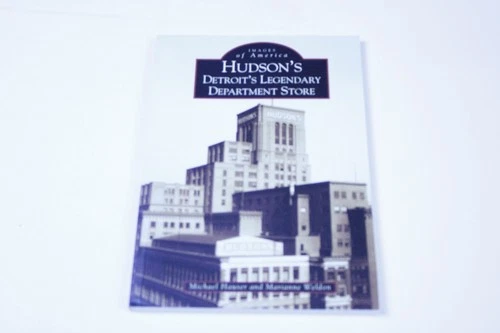

To a kid from the Detroit suburbs, Hudson’s on Woodward Avenue was the closest thing the city had to a cathedral made of commerce. You did not go downtown without visiting it, and you did not visit it without it leaving a mark. The building rose a full block into the Michigan sky, its stone face so tall you had to lean back to take it in, and inside it held what felt like a whole city of goods, of people, of noise and perfume and the chime of elevator bells. Generations of families measured their lives against it. First communion dresses came from the floor that sold children’s clothing. Wedding china was registered there. Newlyweds rode up to the home store and picked out everything for the first apartment they would ever own together. And when the store finally closed in 1983, the grief Detroit felt was real enough to be written about, argued about, and held onto for decades. This book is one of the ways people hold onto it.
Joseph Lothian Hudson opened his first store in 1881, a modest men’s clothing shop on Gratiot Avenue, and he built it into something the city had never seen. He was a merchant of the old school, demanding, exacting, obsessed with value and service. The business moved to Woodward and grew by stages, swallowing neighboring buildings, adding stories, spreading until it occupied the whole block between Gratiot and Farmer. By the middle of the twentieth century Hudson’s was the second-largest department store in the United States, ranking behind only Macy’s in New York, and its flagship was among the tallest department store buildings anywhere in the world. That kind of scale is hard to describe to someone who only knows retail as it looks today, all big-box warehouses and same-day delivery. Hudson’s was retail as civic architecture, a place you went to be impressed, and the buying almost felt like a side effect.
Step inside and the scale became something else entirely. Uniformed elevator operators called out the floors in a musical cadence. The bargain basement moved more goods in a single week than some stores moved in a year. The shoe department was itself larger than most independent stores, and the fur salon and the fine jewelry counters sat up high where the light was good. There was a restaurant, a tea room, and a place to meet for lunch in the middle of a day of shopping, which was the entire point of a store like this. It was not built to be efficient. It was built to keep you, to turn a shopping trip into an event, to give you a reason to dress up and take the bus or the streetcar downtown. Shoppers who remember it talk about the smell of the place, the polish on the railings, the brass, the marble, the particular quality of light falling on a counter of gloves.
Then there was the clock. On the corner of Woodward and Gratiot, at the main entrance, Hudson’s hung a clock that became the single most famous meeting spot in the city. Detroiters arranged their whole social lives around it. “Meet me under the clock” meant one thing and one thing only, and nobody needed the address spelled out. Couples met there before dates. Families reassembled there after splitting up to work different floors. Strangers stood beneath it and struck up conversations that, in at least a few recorded cases, turned into marriages. A clock on a department store corner does not sound like much when you write it down. But for the people who used it, it was a fixed point, something solid and dependable in the middle of a busy life, and it is one of those details that makes the store’s story read more like family history than corporate history.
The store’s pull was strongest at Christmas. The Hudson’s window displays on Woodward were an annual pilgrimage for families from every corner of the metro area, elaborate mechanical scenes that drew crowds into the cold. Santa Claus held court inside the store, and the Thanksgiving parade that Detroiters know today was born there, with the company sponsoring and staging the first one in 1924. For decades the sound of that parade, the giant balloons and the marching bands passing in front of the department store, marked the official start of the holiday season for the whole region. If you grew up in Detroit, the store is woven into your earliest memories of the holidays, of downtown, of the city at its most alive.
Hudson’s was also, quietly, one of the most important employers and institutions in the city. At its height the flagship employed thousands, and for a great many Detroiters the store was a first job, a first paycheck, a first taste of the working world. It trained generations of retail people who went on to run stores of their own. The Hudson family’s money and name reached far beyond the building, into foundations and civic projects that shaped the city for the better part of a century. In that sense Hudson’s was never a chain in the modern sense of the word. It was a Detroit institution, owned and run by people who lived in the city and whose fortunes rose and fell with it.
The end was hard. The store on Woodward closed in 1983, and the building sat empty, a colossal ghost looming over a downtown that was itself struggling. For fifteen years Detroiters drove past it, remembering what had been inside. In 1998 the building was imploded, and on that morning tens of thousands of people gathered to watch a piece of their own memory fall. It was one of the tallest buildings ever demolished that way, and the crowd that came to see it was less a crowd of onlookers than a crowd of mourners. People cried. People held each other. It is a strange thing to grieve for a building, but Detroiters did, because the building was never really just a building. It was the container for a way of living that had already passed, and seeing it come down made that loss impossible to ignore.
What remains is memory, and memory is exactly what this book trades in. The store’s story, told properly, is a story about Detroit itself: the rise of the city, its industrial might, its downtown of streetcars and crowds and polish, and then the long decline that emptied the blocks and silenced the register drawers. That is why histories of Hudson’s find readers well beyond the people who shopped there. Anyone interested in American retail, in the rise and fall of the downtown department store, or in the social history of the Midwest will find in this one store a remarkably complete case study. The store was both a product of its city and a maker of it, and you cannot really understand one without the other.
The book at the heart of this listing is Hudson’s: Detroit’s Legendary Department Store by Marianne Weldon, and the title tells you honestly what is inside. It is a history, written by a Detroit-area author who knows this material the way only someone local does. Weldon walks the reader through the store’s story, from the early days of J.L. Hudson’s little shop to the heights of the great Woodward store, its place in the daily life of the city, and the years that followed its closing. For a reader who lived any part of that story, the book works as a return trip, a chance to revisit the departments, the traditions, and the particular rhythm of a store that shaped so many childhoods. For a reader who came along after the building came down, it is an introduction to a world that no longer exists but still matters to anyone trying to understand what Detroit used to be.
Why bother owning a physical copy when pieces of the Hudson’s story float around the internet for free? Because this is a subject people want to hold in their hands. A history of a store is the kind of thing you keep on a shelf and pick up again, the kind of thing you hand to a parent or a grandparent who will start telling stories the moment they see the cover. It is a gift that carries a city’s worth of memory in a single volume. For collectors of Detroit memorabilia, for people who keep shelves of books about the city, for anyone who has ever tried to explain to a child what downtown used to be like, a clean fresh copy of a Hudson’s history is a small treasure, and the kind of item that does not sit in a warehouse forever.
There is a whole tradition of books like this one, small regional histories that capture a single store, a single neighborhood, a single institution before the people who remember it are gone. They get written quietly, they sell to a loyal audience, and then they go out of print, which is exactly when they start to become hard to find. Detroit has been lucky in this way. The city’s love affair with its own history has produced a steady run of volumes about the places that made it, and the ones that keep coming up in conversation are the ones about the great institutions, with Hudson’s near the top of the list. A Brand New copy of one of those books does not come around often. Most copies in circulation are years old, read a dozen times, worn at the edges. A fresh one, straight out of the warehouse, is the version you actually want if the book is meant to stay in a collection or sit out on a coffee table where it will get picked up again.
Let me tell you about the condition, because for a book like this the condition is the whole game. This copy is Brand New. It is unread, unopened, with no marks on the pages, no dog-eared corners, no underlining, no creases in the spine. What you are getting is the book in the state it left the printer, the way you would receive it from a dealer who has kept it clean and flat rather than the way you would find it in the used stack at a garage sale. For a reader buying this as a keepsake, or as a gift for someone who remembers the store, that matters. A history of a beloved Detroit landmark deserves better than a worn-out reading copy, and this one is pristine.
Shipping is fast and the packaging is careful, because we know what a book like this is worth by the time it reaches your door. We ship within a day of your order, and the book is packed flat and snug so that corners, edges, and binding survive the trip intact. Nobody wants to open a package and find a book that was banged around in transit, and we have been doing this long enough to know exactly how to keep that from happening. From our store to your mailbox, this one will arrive ready for a shelf, not looking like it survived a war.
This copy of Hudson’s: Detroit’s Legendary Department Store by Marianne Weldon is priced at just $4.89, which for a Brand New copy of a piece of Detroit history is about as good as it gets. It is listed on eBay at https://www.ebay.com/itm/127366600182, and it ships from the Wiredwizard store, the same store that keeps books, collectibles, and interesting finds moving out to buyers every week. If you lived it, this book will take you back. If you only ever heard the stories, it will let you in. Grab it while it is still in the store, and let a little piece of Detroit’s great department store come home with you.
AI FAQ
AI FAQ — Hudson’s: Detroit’s Legendary Department Store
1. What is this book about?
It is a history of Hudson’s, Detroit’s legendary J.L. Hudson Company department store, written by Detroit-area author Marianne Weldon. As the title states, it covers the store’s story and its place in the life of the city. This copy is Brand New, unread, and unopened.
2. Who is the author, Marianne Weldon?
Marianne Weldon is a Detroit-area author. The listing identifies her as the author of this history of Hudson’s, and the book reflects the perspective of a writer with local knowledge of the store and its role in Detroit. If you want her fuller biography, the eBay listing itself is the best source for any further details.
3. Where was Hudson’s located?
The flagship store stood on Woodward Avenue in downtown Detroit, occupying the block between Gratiot and Farmer. For the better part of a century it was the anchor of Detroit’s downtown shopping district.
4. When was Hudson’s founded and by whom?
Joseph Lothian Hudson opened the store that would become Hudson’s in 1881. Over the following decades he and the company built it into one of the largest department stores in the United States, with the flagship building on Woodward becoming a landmark of downtown Detroit.
5. When did the downtown store close, and what happened to the building?
The flagship closed in 1983. The building sat empty for years afterward and was imploded in 1998, an event watched by tens of thousands of Detroiters. The book is one of the ways the store’s memory has been preserved.
6. Why do Detroiters care so much about Hudson’s?
Because the store was woven into daily life for generations. People met under the famous clock on the corner, bought their first communion dresses and wedding china there, saw the Christmas windows, watched the parade the company helped start, and thousands worked there. It was not merely a store; it was a civic institution.
7. What does “meet me under the clock” mean?
It refers to the large clock on the outside of the Hudson’s flagship at Woodward and Gratiot. For decades it was the most famous meeting place in Detroit. “Meet me under the clock” was understood by everyone and needed no further explanation.
8. What condition is this copy in?
Brand New. It is unread, unopened, with no marks, no underlining, no dog-eared pages, and a tight uncreased spine. It is essentially in the condition it left the printer.
9. How much does it cost?
The price in the listing is $4.89. At that price, a Brand New copy of a piece of Detroit history is an inexpensive way to own a genuine keepsake.
10. How fast is shipping, and how is the book packed?
We ship within a day of receiving your order. The book is packed flat and snug in protective packaging so the corners, edges, and binding arrive undamaged.
11. Does the book contain photographs and illustrations?
Because we don’t have the interior open in front of us to describe page by page, we can’t make specific promises about individual images. What the listing states is that this is a Brand New copy of a history of the store. For a visual sense of what’s inside, the listing photos are your best reference, and the title makes clear that the book’s focus is the store’s history.
12. Is this a good gift?
Very much so, especially for anyone with a Detroit connection, a parent or grandparent who remembers the store, or a collector of books about Detroit and American retail history. A Brand New copy makes a far better gift than a worn reading copy.
13. Who is the seller, and where does the book ship from?
It ships from the Wiredwizard eBay store, which also operates under the seller name morgatod_9. Orders are processed quickly and packed with care to arrive in the condition described.
14. What if I have a question about returns or shipping terms?
The condition here is Brand New, so the book should arrive exactly as described. For the store’s specific return and shipping policies, the eBay listing is the authoritative source and will show the terms in effect at the time of your order.