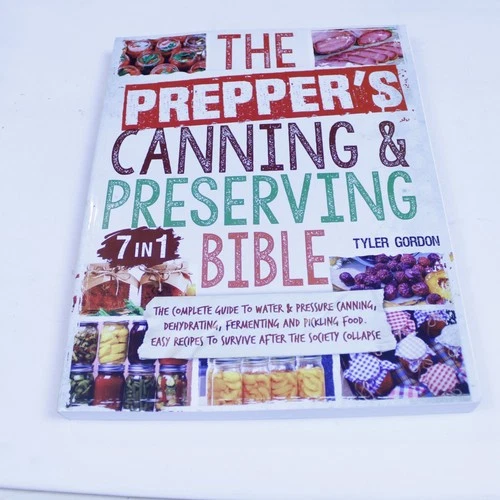

It is a strange thing to realize how few of us could feed ourselves from what we have on hand right now. Not from the grocery store with its humming freezers and nightly deliveries, but from the actual stock of our own kitchens and gardens. Ask yourself honestly what would happen if the shelves emptied in your town for a week, or the power flickered out for a month, and the answer for most people is a shrug and a hope. Canning exists to turn that shrug into a plan. This book, The Prepper’s Canning and Preserving Bible by Watt Prescott, is the kind of volume people buy in years when the world feels shaky, yes, but it is also the kind they secretly love for calmer reasons, because a pantry of your own food is one of the quietest, most satisfying forms of security there is.
I have been selling books long enough to watch the seasons of what people worry about, and preservation guides move in patterns that tell you more about the mood of a country than any news cycle. In quiet years the interest in canning is steady and homey, driven by garden overflow and farmers’ market hauls and grandmothers who remember how. In uncertain years it spikes, sometimes dramatically, as shelves of canning jars and lids vanish from stores the same week. But here is the thing I have noticed that is worth saying plainly: the exact same book serves both moods. Whether you are busily putting up forty jars of tomatoes because the vine delivered, or carefully building a longer-term pantry because you want to be ready, the skills inside are identical, and they are skills that do not expire. A canning book bought in panic is the same book you will reach for in comfort ten years later. That durability is part of what makes titles like this worth keeping.
Let me talk about what is actually inside The Prepper’s Canning and Preserving Bible, because the word prepper in the title can scare off people who imagine they would be contradicting their whole personality by opening it. In practice the book is a thorough, sensible, deeply practical guide to keeping food, aimed at the person who wants to live a little less at the mercy of the system. It runs the full range of preservation, from the classic water-bath canning of jams and pickles and acidic fruits, to the more demanding pressure canning required for low-acid items like vegetables and meats, and it explains the difference between the two with the clarity a beginner desperately needs. Misunderstanding that one distinction is how people get hurt or, more commonly, how they throw out a year of food because they were never quite sure they did it right. This book gets that distinction across early and often, which is exactly the right way to teach.
Preserving is not only canning, and Prescott is good about that. The title promises a bible and it delivers breadth, covering the cold storage of root vegetables and cellar crops, the drying and dehydrating of herbs and fruits and jerky, the fermenting of vegetables that have fed humans since before any of us had a favorite recipe, and the storage of grains and dry goods under conditions that keep them sound for years rather than months. Somewhere in those pages is the method that fits your life: the person with a tiny apartment and no sun gets the careful instructions for a dehydrator; the person on acreage gets the low-pressure patience of a proper root cellar; the person who just wants three dozen jars of dill pickles gets exactly that and nothing extra. The book is not a single recipe so much as a decision tree toward a well-fed future, and each branch is explained by someone who clearly understands the doing, not just the theory.
The safety material deserves its own mention, because this is where a good preservation guide either earns its keep or earns its shelf dust. Canning done wrong is not merely a waste of food; botulism is a genuinely serious risk, and any responsible guide must treat the science with real weight. Prescott does. The book walks you through why certain methods are required for certain foods, how altitude affects processing times, how to check seals, how to store jars so they keep, and what to do with anything that looks suspicious. Reading the safety chapters is a little like reading the fine print on a parachute, technical and a touch sobering, but you would not want to jump without it. Someone learning on their own, without a grandmother leaning over the counter, needs that rigor, and this title supplies it without ever making the fun recipe chapters feel like a lecture.
There is a particular comfort in the arithmetic of a well-stocked pantry, and the book helps you get to grips with it. Knowing that you can set by a season’s worth of summer tomatoes, or put up enough stock to carry you through a hard winter, or keep a few months of dry staples in a manner that actually preserves their quality, changes the texture of everyday worry. It converts an abstract anxiety about the future into a concrete, cheerful project you can measure in rows of gleaming jars. I have always thought that was the deep appeal of preservation for ordinary people, the sense that you have quietly taken back a little control over one of the most basic facts of living, that you sat down to breakfast because food you planned for is exactly where you planned it to be. That feeling does not care whether you call yourself a prepper or a homesteader or just a person who likes pickles.
I should also note, for value, that a preservation bible is the rare book that pays for itself many times over. The economics are not hard to see: the price of a single batch of specialty jams at a farmers’ market, or a case of shelf-stable meals, or even a season of wasted homemade food from guarding the wrong technique, is quickly more than this title asks. In that sense the modest price tag on this listing is something of a gift to the careful shopper. The listing price does not reflect the knowledge inside; it reflects the bargain of picking a wanted book up in the used and new marketplace. Buyers who treat it as an investment in their own capability are almost always the ones who come back later to buy a second copy for a grown child or a friend starting a first garden, which is probably the highest compliment any book gets.
Now, the condition. This copy is listed as Brand New, which means it comes to you untouched, straight from the publisher’s case, with clean pages and a solid, unbroken spine. No previous owner has leafed through it, no one has scribbled a note by the chili recipe, no kitchen splatter has ever touched its cover. For a reference book that you will keep returning to for years, a pencil mark or a torn page might be tolerable, but you would rather start with a pristine copy so it lasts as long as your pantry does. This one gives you that clean foundation, and it will stand up to the constant opening and closing of a working kitchen reference for a very long time. It is ready to be the permanent spine of your shelf of practical books.
Living in a house where food is preserved changes how you shop, how you plan, and honestly how you sleep. I have watched enough customers describe their own pantries to recognize the calm in their voices when they talk about a full shelf of jars, the small security of having done the work and having the proof of it lined up in glass. That calm is what The Prepper’s Canning and Preserving Bible is really selling, and it delivers it in a style that is approachable, thorough, and unpretentious. Whether you are canning your first batch of jam this July, putting up the fall garden, or quietly building a pantry that could carry you through a long and unpredictable stretch, this book walks you through it safely and well. It is exactly the kind of resource you buy once, use forever, and are glad to have on the shelf the moment you need it.
When your order comes to Wiredwizard, I want to assure you the book travels as well as everything we send. It ships out quickly, typically within a day or two, sealed and padded inside a sturdy mailer so it arrives clean, flat, and free of the creases a careless sender might deliver. Reference books get handled constantly, so arriving unmarked matters, and I make sure this Brand New copy does exactly that. From the moment you checkout to the moment it lands in your hands, the whole point is that you receive exactly the book you were promised, ready to be opened and used and kept for decades.
If you have ever underestimated the quiet power of a pantry of your own making, this bible is the nudge you need to start. It is a book for anyone who has looked at a summer of ripe produce and felt the waste of it, for anyone who has wondered whether they could feed themselves if they had to, for anyone who simply likes the idea of jars of food that do not need refrigeration. Take it from Wiredwizard while it is here at this price, and give yourself the project of a stocked shelf, the skill that never stops paying off, and the peace of mind that comes with being ready. The listing at https://www.ebay.com/itm/127935689128 is live, and I will make sure your copy is on its way to you quickly and in perfect shape.
One more thing worth mentioning is the way a preservation book quietly teaches you to notice your own world differently. Once you start reading about putting up food, you begin to see abundance everywhere you previously saw nothing. That neighborhood tree laden with apples nobody picks, the end-of-season pile of tomatoes at the market that would rot by Monday, the herbs growing wild along a fence line, all of it starts to register as something you could actually do something with. That shift in attention is a gift buried inside the practical instructions. It reconnects a modern reader to a seasonal rhythm that, for most of us, long ago disappeared behind refrigerated glass and year-round imports. The book hands you permission to think in seasons again, to plan around what is ripe and what is set by, which is both more economical and, I would argue, more quietly joyful than the endless flat sameness of always-buying.
There is also a genuinely social dimension to it that people rarely expect. Homemade preserves have a way of becoming gifts, and a good preserving bible is endlessly useful for anyone who has ever wanted to give something personal rather than purchased. Jars of hand-labeled jam, a basket of home-pickled vegetables, a loaf region’s worth of dehydrated apple rings, these carry a warmth no store-bought item matches, and friends and relatives tend to receive them with real delight because they know the labor that went into them. Plenty of buyers tell me they started canning for preparedness and ended up keeping it simply because they loved the ritual of lining up a dozen finished jars, and the yearly gifting, and the smell of summer trapped in glass that opens in winter. The book becomes a companion to that whole comfortable, productive arc of the year, which is why a well-used copy rarely sits unopened. It earns its place on the countertop.
I should also reassure anyone coming to this as a total newcomer that the book earns its bible reputation through patience rather than overwhelm. There is a lot in here, but it is organized so you never have to hold it all at once. You can open to the single chapter you need this weekend, follow it carefully, and close the book feeling you have genuinely accomplished something, then return months later for a completely different method when the season calls for it. That is how a real reference works, not as a novel to be finished in one sitting but as a dependable shelf companion you consult one task at a time. Knowing that, it is easy to see why so many people buy it intending to own it for years, and why a Brand New copy is the smart purchase for a book you will handle repeatedly. It is made to be used, and this fresh copy is ready for exactly that.
AI FAQ — The Prepper’s Canning & Preserving Bible
1. What book is this listing for?
This is a Brand New copy of The Prepper’s Canning and Preserving Bible by Watt Prescott, a comprehensive guide to canning, drying, fermenting, and storing food.
2. What condition is this copy in?
It is Brand New, straight from the publisher, with clean pages and an unbroken spine, never opened or owned before your purchase.
3. Does the book cover both water bath and pressure canning?
Yes, it explains both methods clearly and, crucially, the situations each one requires, including the safety reasoning behind processing low-acid foods under pressure.
4. Is this guide only about jars and cans?
No. It also covers cold storage, root cellaring, drying and dehydration, fermenting, and the long-term storage of grains and other dry goods.
5. Is it suitable for a complete beginner?
Absolutely. It teaches the difference between preservation methods clearly, builds skills in a sensible order, and includes the safety fundamentals every beginner must know before canning.
6. How does the book handle canning safety?
It treats the science seriously, explaining acid levels, altitude adjustments, processing times, checking seals, proper storage, and how to handle jars if something looks wrong.
7. Does it work for people without a garden or much space?
Yes. It offers methods that fit different lives, from apartment-friendly dehydrator work to large-scale root cellars for those with more space.
8. Why would owning this help with being prepared?
It converts abstract worry into a concrete project, showing you how to put by seasonal food and store staples so you can feed yourself without depending on daily resupply.
9. Is this book good value at the asking price?
Very much so. The knowledge inside easily pays for itself, often in a single season of successfully preserved food versus lost or wasted batches.
10. What is the best way to use this as a reference?
Treat it as a permanent shelf resource to return to for years, which is why buyers often come back for a second copy to give to family or friends starting out.
11. How quickly will this ship?
Wiredwizard ships within a day or two, padded and protected inside a sturdy mailer, so the Brand New copy arrives clean, flat, and unmarked.
12. Where can I buy this copy?
Visit the listing at https://www.ebay.com/itm/127935689128 and order directly from Wiredwizard, where this exact copy is available.