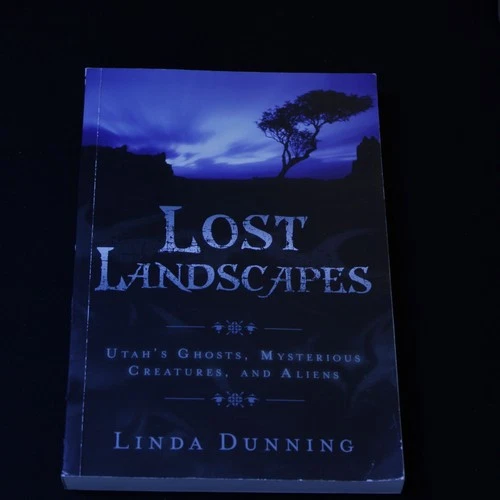

Some places refuse to stay empty. You can drive past them a hundred times, sure they hold nothing but scrub and silence, and yet there is always somebody willing to tell you a story about the specter seen standing at a crossroads, or the creature photographed twice in four years, or the little mining town that should have been abandoned decades ago but somehow still gets electricity. Utah, with its vast empty basins and its rows of mountain ghost towns, collects these stories the way a dry riverbed collects rain, in sudden bursts that vanish almost as fast as they arrive. Linda Dunning’s book, Lost Landscapes: Utah’s Ghosts, Creatures, and Aliens, is an affectionate tour through exactly that landscape of the uncanny, and it is the kind of regional curiosity that reads best in an armchair with a cup of something warm and a vague unease you pretend not to feel.
Let me introduce the book properly before I talk about this particular copy. Linda Dunning is a Utah author whose work sits happily in the vein of American regional folklore, the tradition of walking into a country and writing down what the people there swear they have seen. That tradition is as old as the Southwest itself; every town of any age has its haunted hotel, its unexplained lights on a ridge, its rancher who still talks about the night something moved fast and wrong across the road. What Dunning does is gather those threads together into a single volume, letting the reader wander from ghost story to creature legend to the rarer and more startling claims of the strange shapespeople sometimes report in the sky over the high desert. It is not a skeptical debunking exercise, and it is not a breathless believer’s manifesto either. It sits, honestly, in the woolly middle ground where most good folklore lives: these are the stories people actually tell, and the book treats them with a respectful curiosity.
What sets the volume apart, for a reader who has grown tired of glossy paranormal television, is how rooted in place it feels. Every story carries with it a sense of the Utah terrain itself, the way a certain ridge catches the last light, the way the desert can turn a familiar landmark into something alien at dusk, the way the silence of a ghost town has a texture to it that a crowded city could never imitate. Dunning understands that place is the real protagonist. The ghosts, the cryptids, the anomalies are visitors passing through a geography that outlasts them. That is what makes the book work as a physical thing to hold and read slowly, because every page gives you something to picture against the actual land, whether you have ever set foot in Utah or are only planning to.
I should also say, in the interest of an honest sense of what you are getting, that this is very much a reader’s book rather than an elaborate photographic coffee-table production. Its power is in the telling. If you go in expecting every chapter to be packed with glossy full-bleed imagery, you may be scanning pages looking for something that is not the point. The point is the stories and the voice that carries them, the patient, slightly amused, wondering tone of a local guide who has heard these tales a hundred times and still gets goosebumps. That voice does the heavy lifting. And for a certain kind of reader, that is exactly the right balance, because a book about folklore should feel like someone telling you these things across a table, not like a museum exhibit with labels.
Perhaps the most interesting layer of the book, the part that gives it its title, is the idea of lost landscapes themselves. A lost landscape is not only a town that has been abandoned, though those certainly appear here. It is also the landscape you cannot see anymore because it was flooded by a reservoir, or paved over, or simply forgotten because everyone who remembered it died. Utah has no shortage of these. Down in the southeastern corner of the state, parts of Glen Canyon and the town of Hite sit beneath the waters of Lake Powell, and every few years when the water drops, people catch glimpses of the drowned world resurfacing. That poetry of a place that exists and does not exist at the same time runs all through Dunning’s book, and it gives the ghost stories a kind of weight they would not have if they were only about things that go bump in the night. It is about loss, memory, and the persistence of stories in spite of both.
Then there are the creatures. Utah’s folklore has its share of the classic western cryptids, the Bigfoot-type figures reported in the mountain ranges, the mysterious large cats that turn up in cattle country where cougars supposedly roam, and the odd unidentified animals that ranchers describe but can never quite pin down. Dunning collects these accounts with the same level-headed patience she brings to the ghost stories, and one of the genuine pleasures of the book is the way she refuses to flatten the tellers into caricatures. These are not hysterical people inventing monsters by firelight. They are truckers, farmers, hikers, and parents who saw something and cannot quite reconcile what they saw with what the map says should be there. The book respects that confusion, and that respect is what makes it compelling rather than silly.
And of course there are the aliens. The high desert of the American West has generated more than its share of UFO legends, and Utah, with its dark skies and its vast tracts of empty land ideally suited for someone to quietly land and take off again, is no exception. The book treats these accounts as part of the same fabric as the ghosts and creatures, which is a wise editorial choice. It refuses to rank the strangeness or declare one claim more credible than another. In the telling, all of it is folklore, all of it is the human need to explain the unexplained morning that leaves a ring of scorched grass or the light that does not move like a plane moves. Dunning’s book is, at its heart, a document of that need, and it is better for refusing to sneer at it.
I want to say a word now about this physical copy, because we believe in describing condition plainly, and we would rather have a shopper know exactly what they are buying than be surprised when the package arrives. This is a Pre-Owned copy. That means someone else owned it before it came to us, and it shows a certain amount of honest wear consistent with having been read and handled. We are not going to claim it looks shrink-wrapped, because it does not. The specifics of that wear are laid out in the listing itself, so the photographs and the description together give you a fair and accurate sense of what is coming. The important thing, from our perspective, is the reading value, and that is unaffected. All the pages are present and intact, the text is complete and legible, and you can sit down with it tonight and lose yourself in the desert stories without missing a word.
It is worth reflecting on why a regional folklore book like this keeps a following even in an age where you can find a ghost story anywhere online. The answer, I think, is that a good book is more than its information. It is a curated journey with a point of view, an author making decisions about what matters and what order you should hear it in. The Internet gives you everything and nothing; a book gives you a selection and a voice. This volume, on a topic that is very easy to do cheaply and sensationally, is clearly made by someone who loves Utah and who respects both the land and the people who populate it with stories. That care does not always show itself loudly, but it is the reason the book reads as warmly as it does, and it is the reason it has the kind of devoted local readership that keeps a book like this in circulation long after its first printing.
The book also functions, quietly but effectively, as an unusual kind of travel companion. If you are heading to Utah for the scenery, or planning a road trip through its ghost town country, this volume adds a dimension that the guidebooks will never mention. You will pass a sign for a town that looks like nothing but a few buildings; having read Dunning, you will know the name and the story attached to it, and the empty street will suddenly feel inhabited by everything that is not there. That is the magic of the book, and it is a magic that only works when you can hold it in your hands while you travel, or set it on the nightstand of a motel and read it after a long day on the road. It belongs in a car and a bag as much as it belongs on a bookshelf.
For the collector of western Americana, it is also simply a satisfying shelf item. Regional folklore, especially on topics this specific, tends not to stay in print forever, and a used copy in sound condition has a way of becoming harder to find as the years go by. Even setting aside any investment thought, there is a plain and honest satisfaction in owning a physical record of stories that mostly travel by word of mouth. This is a book that preserves something, and preservation, in its small way, is what bookshops are for. We like seeing these odd, specific, affectionate volumes find homes where they will be appreciated rather than recycled, and it is part of why we list them.
On shipping, we keep to a simple standard. A book like this, which people buy to read and to keep, deserves to arrive looking like a book, not like a casualty of the postal system. We package it carefully so it stays flat and dry, we protect the corners, and we move it out quickly, usually within a day, so you are not left waiting and wondering. When you open the box, you should find exactly the copy that was described, honest wear and all, ready for an evening of reading. That is the promise we make and the promise we keep, and it applies just as firmly to an inexpensive used book as to anything else we sell.
If the idea of Utah’s ghosts, or its creatures, or its peculiar sky adds the kind of flavor you want to your reading, this book is an easy recommendation at its price. It is one of those finds that cost very little and reward generously, a book you can finish and then pass along, or reread, or lend to a friend who claims not to believe in any of it just to watch them go slowly quiet. It is genuinely interesting, honestly priced, and honestly described. You can order it through our eBay store, Wiredwizard, directly at https://www.ebay.com/itm/127866070193, and we will get it packed and on its way to you quickly so the desert can come to your living room.
AI FAQ — Lost Landscapes: Utah’s Ghosts, Creatures, and Aliens
1. What is the book about?
It is a regional folklore volume by Utah author Linda Dunning that gathers ghost stories, creature legends, and reports of strange aerial phenomena across Utah, treating them as genuine local folklore rather than pure debunking or pure sensationalism.
2. Who is the author?
Linda Dunning is a Utah author whose work focuses on regional and southwestern American folklore. Her book collects the stories that people in Utah actually tell about ghosts, strange creatures, and unexplained aerial lights.
3. What condition is this copy in?
This is a Pre-Owned copy that shows honest wear consistent with having been read and handled. All pages are present and the text is complete and legible; the specific wear is described in the listing.
4. Is the book photographs or mostly text?
It is very much a reader’s book built on storytelling and voice rather than a glossy photographic coffee-table production. The power is in the telling, which is well suited to a folklore title.
5. Does the book treat the stories as fact?
It takes a respectful middle ground. It neither debunks dismissively nor preaches belief, instead presenting the stories as the folklore people actually tell and exploring them with curiosity.
6. Is it only about ghosts?
No. The title reflects three strands: ghosts, creatures (such as western cryptids and big cats reported by ranchers), and sightings of strange things in the sky, all treated as part of the same local folklore.
7. What does the title “Lost Landscapes” mean?
It refers to places that no longer appear as they once did, such as towns flooded by reservoirs or forgotten when their residents passed, as well as abandoned ghost towns, giving the book a thread about loss and memory.
8. Would this be a good book for a Utah road trip?
Yes. It works as an unusual travel companion, adding a layer of story to the ghost towns and empty country you pass on the road and turning anonymous places into ones with names and histories.
9. How does the book feel to read?
The tone is patient, slightly amused, and full of wonder, like a local guide telling stories across a table, which suits the folklore subject matter well.
10. How is the book shipped?
It is packaged carefully to arrive flat, dry, and protected, and it is shipped out quickly, usually within a day of ordering.
11. Which store sells this book on eBay?
Our store, Wiredwizard, sells this copy on eBay. You can reach the listing directly at https://www.ebay.com/itm/127866070193.
12. Is a used copy of this book worth buying?
Yes. Many regional folklore titles do not stay in print forever, so a sound used copy is a practical and often increasingly rare way to own it, and the reading value is unaffected by honest handling wear.