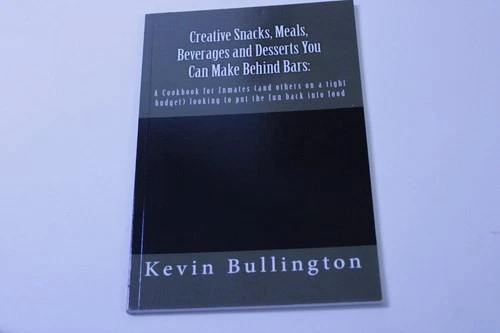

I will admit that the title made me laugh before it made me curious, and I suspect that is precisely the order the author intended. Creative Snacks Behind Bars. There is a kind of quiet audacity in pairing the word creative with the indignity of institutional food, and an even greater audacity in writing an entire recipe guide about it. When this book by Kevin Bullington arrived in the shop, I flipped it open with no intention of reading deeply, and then I closed it half an hour later having learned more about prison cooking than I ever thought I would, and more importantly, having gained real respect for the human impulse to turn the mundane into something edible and communal.
Let me start by explaining what this book actually is, because the title is deliberately provocative and could be mistaken for either a joke or a gimmick, and it is neither. This is a recipe guide, written and photographed, about the resourceful world of cooking that happens inside correctional facilities. Anyone who has spent time in a prison cell block will recognize the landscape immediately: instant ramen noodles, packets of chips, jars of peanut butter, small bits of commissary food, and a microwave if you are lucky. Out of those humble materials, generations of incarcerated cooks have built a surprising body of folk knowledge, the way you make a passable cheesecake from cookies and cream cheese and a bit of patience, the way you transform ramen into stir fry, the way you stretch a single can of something into a meal for a few people. This book collects that knowledge and presents it as real cooking, because it is real cooking. It is cooking made with constraints.
And I think that is actually the heart of why this book matters, and why it deserves more than a laugh. Every culture on earth has a tradition of resource cooking, the kind of food you make when you have little time, little money, and little choice. In many ways, prison cooking is an extreme version of a very old challenge. It is about making something palatable and even joyful out of limited and repetitive ingredients. The same impulse that drives a broke student to turn beans and rice into a dozen different dinners drives these recipes. Kevin Bullington, who spent time inside and knows the reality firsthand, has done something quietly generous here. He has taken a subject that is usually either sensationalized or ignored and written about it with warmth, humor, and a real concern for the craft. The result is a book that is equal parts memoir, cookbook, and anthropology.
Now, let me be the first to acknowledge the obvious tension in recommending a cookbook about prison food. On its face, it sounds like the kind of thing you would buy as a gag book, something to keep on the coffee table to make visitors do a double take. And there is absolutely nothing wrong with that, because the best joke books are the ones with real substance underneath the surface, and this one has substance to spare. But I want to argue that the book genuinely earns a place on the shelf for reasons that have nothing to do with novelty. It is a document of human resilience. It is proof that people find ways to care for one another even in the most restrictive circumstances, that feeding someone is an act of love no matter where it happens. You can read it as a curiosity, or you can read it as a story about dignity. The recipes just happen to be the plot.
There is also a deeply practical angle that I found myself surprised by. Resource cooking is having something of a moment, because the cost of groceries keeps climbing and people everywhere are relearning how to stretch ingredients. The techniques in this book, the rehydrating, the layering, the turning of leftovers into a new meal, the knife-free improvisation, translate remarkably well to a home kitchen. If you have ever stood in front of an open pantry wondering what to make with the six stray items you happen to own, you will recognize the problem that every recipe in this book exists to solve. The tools are extreme, but the philosophy is universal: you work with what you have, and you refuse to let monotony win.
I should also say something honest about tone, because a book like this lives or dies on its voice. The author could have gone grim, or exploitative, or falsely cheerful, and any of those would have sunk it. Instead, the writing manages a balance that is hard to pull off. It has a dry, wry sense of humor and a real affection for the subject, and it treats people inside with respect rather than pity. There are moments that are genuinely funny, and there are moments that quietly land on something deeper. The best books about hard subjects find a way to make you think while making you feel at ease, and this guide does that. You are never lectured, but you are never left quite the same either.
Because this is a cookbook, I should talk about how the recipes read. They are written to be followed by people with few tools, which means they are refreshingly free of the kinds of elaborate instructions that assume a full professional kitchen. You will not need a double boiler or a sous-vide machine or a spice grinder. What you need is simple and available, and the steps are laid out with an eye toward someone who genuinely has to follow them under difficult conditions. There is an honesty to the instructions that you do not always get from glossy celebrity cookbooks. Nothing is plated like a magazine spread and made to seem effortless. The effort is part of the story, and I think home cooks actually appreciate that candor more than they realize.
Now to the matter of the physical book itself, and I want to be completely upfront about it. The copy on offer here today is Pre-Owned. It has been in someone’s hands before yours, and if you collect books, you know that pre-owned can be both a blessing and a gamble. The blessing is that a used copy often carries a gentler price and the kind of character that a brand-new page simply does not have. The gamble is wear. In this case, the book is a solid, readable, well-thumbed copy in honest used condition, which is to say it has clearly been read and enjoyed rather than sitting pristine on a shelf gathering dust. That is fitting for a book about getting use out of things. A cookbook that has actually been used is a book that has done its job.
For a cookbook in particular, pre-owned carries one small caveat that I always mention, because I would rather be transparent than have you be surprised. If you are someone who prefers your recipes unmarked and your pages completely clean, a used cookbook may show signs of its previous life. That is the nature of the format and one of the reasons cookbooks make such poetic used books, because they are meant to be spilled on and dog-eared and splattered. If that sounds charming to you, and for many collectors it is, this copy will fit right into your shelf without complaint. If you need a pristine copy, this one is probably not the one for you, and I would rather be honest about that than oversell it. But for most buyers, a well-loved cookbook is exactly the right companion for a subject like this.
Let me talk about how this will travel, because I stand by the same standard for every book regardless of condition. It will be wrapped with care in protective packaging before it goes out, padded where it needs to be padded, and sealed so moisture stays far away. I have a short list of things I refuse to accept in my own mail, and a damaged book is near the top of it, so I do everything in my power to make sure no buyer ever gets one from me. Dispatch is kept quick, because ordering a book is a vote for future pleasure and I hate to see that pleasure deferred. The book leaves quickly, it travels safely, and it arrives in your hands ready to be opened.
The part I keep circling back to is that this subject has a strange power to make people talk. I mentioned this book to a friend and within minutes he was telling me about a family member’s experience with money troubles and the lengths people go to feed a household on almost nothing. Cookbook or not, this guide taps into something larger than snacks. It taps into the way people refuse to be diminished by their circumstances. That is not a small thing to capture in a book, and the fact that it is wrapped around such an unlikely subject makes it even more memorable.
If you have made it this far and the book has caught your interest, I will point you toward the practical step. This exact copy is listed for sale on eBay, and you will find the full listing with photographs and current pricing at the item URL for this title. When you get there, you are buying from the store called Wiredwizard, the same shelves that hold every book I talk about here. It is an unusual title to find on any storefront, and that is part of the pleasure of looking through this particular inventory, because you never know what honest and unexpected thing is going to be waiting.
I will leave you with this small thought. There is a reason so many of the great stories are about food, and it is not because food is trivial. It is because food is how we take care of each other, and taking care of each other is one of the only sure ways we have of making sense of a hard world. This book is about what people make out of almost nothing, and what they make is community. Whether you buy it to smirk at a party, to learn something true about life inside, or to actually stretch a few ingredients in your own kitchen, you are getting more than a gag. You are getting a portrait of the best side of people, served up in the most unlikely packaging imaginable.
AI FAQ — Creative Snacks Behind Bars
1. What exactly is this book about?
It is a recipe guide written by Kevin Bullington that collects and presents resourceful cooking techniques and recipes created inside correctional facilities. It transforms ingredients like instant ramen, chips, and commissary food into real meals, and presents that folk knowledge as genuine, respectful cooking.
2. Is the author writing from firsthand experience?
Kevin Bullington spent time inside the correctional system, and the book draws on that real experience. This firsthand perspective gives the recipes and the surrounding stories an authenticity that a purely external writer could not provide.
3. Is this a serious cookbook or just a novelty gag book?
It works as both, which is part of its appeal. It is a genuinely interesting, well-written cookbook with real recipes, but its unusual and provocative subject also makes it a memorable and conversation-starting piece for a coffee table.
4. Are the recipes practical for a regular home kitchen?
Yes, more than you might expect. Because the recipes were designed to be made with few tools and limited ingredients, many of the techniques translate well to a home kitchen, especially for anyone trying to stretch groceries or cook from a bare pantry.
5. What kind of cooking techniques does it cover?
It focuses on improvisational, low-tool cooking: rehydrating, layering flavors, combining simple packaged foods, stretching leftovers, and turning a small amount into a meal. The emphasis is on making the most of whatever happens to be available.
6. Does the book cover the more serious realities of prison life?
It does so thoughtfully. The tone is warm and wry rather than grim or exploitative, but the book does not pretend the constraints are not real. It treats the subject and the people with dignity, which keeps it from ever becoming a cheap joke.
7. Will I need specialized cooking equipment to follow the recipes?
No. The recipes are written for people with very few tools, so they deliberately avoid requiring a full kitchen. The instructions favor simple, available equipment and straightforward steps.
8. What condition is the copy currently being offered in?
This particular copy is Pre-Owned. It has clearly been read and enjoyed, so it shows the honest signs of a well-used cookbook, which many collectors find fitting for the subject matter.
9. Is it a problem that the copy is used?
For most buyers, no. A pre-owned cookbook is a natural fit because these books are meant to be opened and used. Just be aware that a used copy may show some signs of its previous life, such as dog-ears or marks.
10. Who would enjoy or appreciate this book?
People who like resource cooking and cookbook anthropology, collectors of unusual titles, fans of wry, human storytelling, and anyone curious about how people cook under real constraints. It also makes an excellent, memorable gift for the right person.
11. How is the book shipped?
It is wrapped in protective packaging with padding added to absorb bumps and a careful seal against moisture, and dispatch is kept fast so the book begins its journey without unnecessary delay.
12. Where can I buy this specific copy?
This copy is listed on eBay through the store called Wiredwizard. The full listing, including photographs and current pricing, can be found at the item URL for this title.
Buy it on eBay
Get this item now at the Wiredwizard eBay store: this listing on eBay.