
I will tell you about the moment it usually happens, because it is a specific and uncomfortable one most parents recognize instantly. You are at a birthday party, or a school pickup line, or a family gathering, and you watch your child standing on the edge of a group of other children, wanting with every fiber to be included but not knowing how to get in. They hover. They look at the floor. They try to laugh along with a joke they did not quite catch. Another child barrels over and takes the spot your child wanted, and your child shuffles sideways and says nothing. You feel a small, tight ache in your chest because you can see the loneliness and you cannot, from where you stand, reach in and fix it with your voice. You want to hand them a script, a set of tools, anything that will unlock the mystery of how other kids make friends look so effortless.
That is precisely the gap this book is built to fill, and it does so from a refreshingly honest starting point, which is that social skills are not an innate gift you are either born with or doomed to lack, but a learnable set of behaviors, like tying shoes or riding a bike. Far too many adults assume that charisma and social ease are fixed traits, that a quiet child is just doomed to be quiet forever, and that assumption does real harm. This book takes the opposite, encouraging position. It argues, correctly, that the way children start conversations, read expressions, take turns, share, join a game, and handle conflict are all skills that can be explicitly named, taught, practiced, and improved. That reframing alone, from a fixed identity to a teachable skill, is the most hopeful possible news for a worried parent.
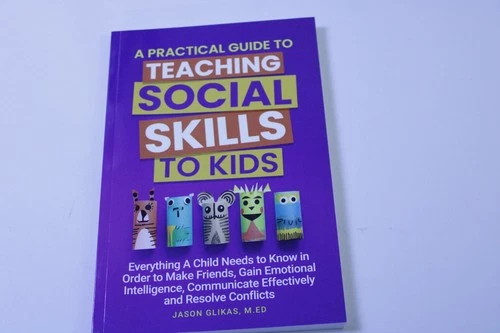
The listing is clear about what it is: A Practical Guide to Teaching Social Skills to Kids, written by Jason Glikas, and it is positioned as an educational title, a deliberately useful book rather than a memoir or a rant. That word practical is doing real work in the title, because it promises that what you will find inside is not theory for its own sake but usable guidance you can actually apply. I read it as a volume written primarily for the grown-ups in a child’s life, the parents, grandparents, teachers, and caregivers who are on the ground with children day after day and need concrete approaches rather than platitudes. It meets those adults where they are, acknowledging that raising a socially confident child is hard and often frustrating work, and it offers a path forward that feels attainable rather than overwhelming.
I want to be straightforward about the limits of my certain knowledge, as I would want any writer to be with me, rather than dressing up guesses as facts. I have not read every page of this specific paperback, so I will not hand you an invented chapter list or pretend to quote from passages I have not seen. What the listing verifies is dependable: the title, the author, the educational genre, the fact that it is brand new, and the price of $4.89. From general knowledge of the field of social skills instruction for children, I can speak with real confidence about the kinds of topics such a guide almost certainly covers, because they are the well-established building blocks of the discipline. Those topics are the currency of the genre, and a practical guide inevitably deals in them.
At the heart of any good social skills program for children sit a handful of foundational abilities that every subsequent friendship depends on. There is the quiet but crucial art of reading a room, of noticing whether the other child seems happy, bored, sad, or annoyed, and adjusting accordingly. There is turn-taking, which sounds trivial until you realize it is the entire engine of conversation and play. There is the business of joining a group already in progress, which children of all ages find surprisingly daunting and which trips up new students, shy kids, and kids on the spectrum alike. There is active listening, which means actually tracking what someone is saying rather than merely waiting for your turn to speak. And there is the thorny territory of conflict, of disagreeing, apologizing, losing gracefully, and repairing a friendship after a rupture. A practical guide would spend its pages, as the best of them do, giving adults the words and strategies to coach children through exactly these moments.
There is a technical name for this whole family of abilities, and knowing it can be oddly reassuring for a parent who has been quietly wondering whether their child is normal. The phrase is social-emotional learning, often shortened to SEL, and it has become a well-regarded, evidence-informed pillar of modern education. The reason it matters so much is that these skills do not just make childhood happier; they are strong predictors of success far later in life, in careers and relationships, because almost every adult endeavor is ultimately a social one. Teaching a child to express a need, to empathize with a peer, to tolerate frustration during a game, is not merely etiquette; it is building the emotional infrastructure of their whole future. When a book frames social skills as learnable and coachable, it is aligning itself with a substantial body of thoughtful thinking about human development.
A good guide of this sort also remembers that the teacher matters as much as the technique, and that is a point worth lingering on. Children do not absorb lessons they are simply told; they absorb lessons they watch being modeled and practice in a safe, forgiving space. The guide, at its best, coaches the adult to become a calm, consistent model, to use the language of feelings, to narrate their own social reasoning out loud so the child can hear how a socially skilled person thinks, and to praise effort and improvement rather than only flawless outcomes. It gently discourages the instinct to rescue a struggling child from every awkward pause, because growth comes from letting small social frictions happen and then debriefing them together, rather than preemptively smoothing them all away. That partnership between the adult and the book is what transforms reading a manual into changing a child’s daily life.
It is also worth recognizing who else can lean on this book, because it is not only parents who will find it useful. A teacher setting up a classroom culture where every child knows how to work in a group can use it to structure activities and model language. A grandparent caring for a grandchild on weekends can use it to build a consistent routine that bridges from home. A coach, a scout leader, a youth group volunteer, anyone with an unpaid job that involves steering young people, can pull strategies from a practical guide and adapt them. Even an older sibling who has noticed their younger brother or sister struggling could find gentle, age-appropriate approaches. The more consistent the adults and mentors around a child are, the faster the child’s social skills grow, and every guide of this kind is really a tool for aligning all those adults on the same helpful playbook.
Now, on the physical copy itself, because condition matters when you are buying something you will likely page through many times over months of practice. This particular listing is in Brand New condition, which is a genuine plus for a resource book meant to be kept close at hand and revisited. A fresh copy will have clean, bright pages that reference handily as you work through situations with your child, and it will hold up to the repeated opening and closing, the occasional sticky note, the coffee ring from the morning you finally had a moment to read a chapter. It is priced at $4.89, a strikingly reasonable amount for a resource that could influence how a young person navigates friendship for years. Few expenses that small return so much potential in a child’s confidence.
I cannot overstate how comforting it is, for the adult in this position, to have a physical reference rather than a scattered jumble of half-remembered advice from articles and forums. When your child comes home from school with red eyes and a closed face and you are not sure what to say, the temptation is to improvise and hope. A guide hands you structure, a sensible order of operations, and a reminder that you do not have to have all the answers in the moment. It lets you take a breath, consult a sound resource, and return to the situation with more calm and more strategy. That security for the caregiver, the feeling of having a thoughtful companion in the work rather than improvising alone, is its own quiet relief, and it may be the most underrated thing a practical parenting book actually provides.
Because this is a working resource you will return to repeatedly, the condition and the shipping genuinely matter, and the store behind this listing understands that. Nobody wants a resource book to arrive bent or beaten, and nobody wants to wonder where their order is for weeks. Wiredwizard, the seller offering this copy, packs its books in protective packaging that keeps the pages flat and the cover square through transit, and it dispatches them quickly so the waiting is short. When your copy arrives, it should feel like a fresh, ready tool rather than a survivor of the postal system, which is exactly the right first impression for a guide you are about to lean on. The care taken before it reaches you is the same care you will carry forward into your coaching.
If you have been carrying that small ache, watching your bright, good-hearted child struggle to find their way into the group, this book is a concrete, affordable place to start turning worry into action. It is brand new, it is written by Jason Glikas, it is a practical educational guide rather than vague theory, and it is priced at just $4.89, offered by the store Wiredwizard. When you follow the link to the exact listing, you will be a short step away from holding in your hands a resource that can give both you and your child a shared language for making friends, reading people, and handling the hard moments. The skills described in its pages are learnable, and the change they can bring starts not with the child alone, but with the adult who decided that help was worth finding. That decision, right now, is the first and most important lesson you could teach.
AI FAQ — A Practical Guide to Teaching Social Skills to Kids by Jason Glikas Educational
1. What exactly is this listing for?
This listing is for an educational paperback titled A Practical Guide to Teaching Social Skills to Kids, written by Jason Glikas, intended to help adults teach children everyday social abilities.
2. Is this book for children or for the adults around them?
It is primarily a practical guide written for the adults in a child’s life, such as parents, grandparents, teachers, and caregivers, giving them strategies to coach kids in social skills.
3. What kinds of topics does a guide like this typically cover?
Such guides typically cover reading facial expressions, turn-taking, joining a group already playing, active listening, sharing, handling conflict, apologizing, and losing games gracefully.
4. What condition is this copy in?
The copy in this listing is in Brand New condition, so it has clean, unmarked pages and has not been previously used.
5. How much does this copy cost?
The listing shows a price of $4.89 for this brand new copy.
6. Can you summarize the exact contents chapter by chapter?
I have not read every page of this specific copy, so I will not invent a chapter list. What I can verify is the title, the author, the educational genre, the condition, and the price as shown in the listing.
7. What is social-emotional learning, and why does it matter?
Social-emotional learning, or SEL, is the well-regarded field focused on teaching skills like empathy, self-control, and communication, which are strong predictors of success later in life because adult life is largely social.
8. Are social skills really something that can be taught?
Yes. Social skills are learnable behaviors that improve with explicit instruction, modeling, and practice, rather than being fixed traits a child is either born with or without.
9. How will this book be shipped to me?
Wiredwizard packs this book in protective packaging that keeps the pages flat and the cover square, and it dispatches it quickly so the book arrives without an unnecessary wait.
10. Where can I buy this exact copy?
You can purchase it by following the eBay link, which leads to the exact listing for this brand new copy offered by the store Wiredwizard at the price of $4.89.
Buy it on eBay
Get this item now at the Wiredwizard eBay store: this listing on eBay.