
The Symbolist movement is the great moody teenager of art history, and I mean that exactly as the compliment it sounds like. It arrived in the late nineteenth century, swooning and dramatic and utterly convinced that the visible world was only a thin curtain standing in front of a much stranger truth that lay behind it. While the Impressionists were out in the sunlight chasing straw and water lilies, the Symbolists lit candles, pulled the curtains closed, and went hunting for meaning in dreams, in myth, in the tangled recesses of desire and death and the divine. No painter embodied that entire sensibility like Gustave Moreau. His canvases are dense with gold leaf, with jewel-like color, with figures pulled from mythology and scripture and the fever dreams between them, and they shimmer with a strange, hypnotic intensity that looks like nothing else in art. And this, this deck of playing cards, is where his strange beauty has found a wholly unexpected second life. If you gave me an open bar and a blank check I could not have invented a more perfect object to sit on a collector’s shelf.
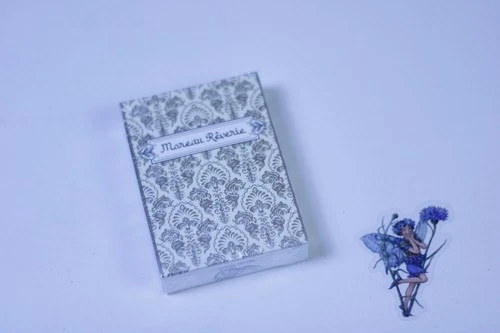
Let me make sure I am being clear about what is in front of us, because the title is doing a lot of work and I want you to actually picture it. This is a set of playing cards, produced as a fine art edition, whose designs are drawn from the work and the aesthetic world of Gustave Moreau. We are talking about a “Journey into decadent Gustave Moreau Symbolism” deck, and that word, decadent, is doing real lifting here, because Moreau is nothing if not decadent in the way that term was meant in his own time, lavish, ornate, gold-encrusted, unapologetically sensuous and otherworldly. Each card, surely, is a small work of art in its own right, carrying the flavor of his Byzantium-tinged palette, his dreamlike figures, his obsessive, jewelled surfaces. This is not the deck you play poker with on a Tuesday night, not the deck that lives in a drawer under the beer cans. This is the deck you display, the deck you bring out to quietly admire, the deck you hand to an art lover and watch their face change.
Now, I want to zoom out for a moment, because to appreciate what this deck is doing you have to appreciate the painter at its heart, and Moreau deserves the attention regardless of whether you ever buy a single card. Born in Paris in 1826, he came of age in a century that was obsessed with progress, with industry, with the machine and the city and the march of the modern. Moreau turned his back on as much of that as he could. He built his career in the studio, elaborating on themes from classical mythology, the Bible, and mediaeval legend: Salome dancing before Herod, the Chimera, Oedipus, the sphinx, tragic queens and fatal women and beings that exist somewhere between gods and hallucinations. His technique was almost obsessively refined. He labored over details, over the gleam of a jewel, the fold of a robe, the eerie pallor of a face, and he wrapped it all in a decorative splendor that has caused later critics to call him precursive to everything from Surrealism to high fashion.
There is something genuinely fascinating, and frankly a little funny, about the contrast between the two ends of this object. On one end you have the gaudy, decorative, high-romantic world of Moreau, a world of tragic damsels and mythical beasts and religious ecstasy rendered in gold. On the other end you have the humble playing card, a mass-produced cardboard rectangle designed for hand-to-hand combat over a folding table, a thing whose entire purpose is to be shuffled, dealt, bet on, and worn down. Pairing those two worlds together is either a terrible idea or a brilliant one, and as I sit looking at this deck I am convinced it is the latter. It takes the ultra-couture and drops it into the most democratic object we have, and the tension between the two creates something genuinely alive. Art is supposed to surprise you by landing somewhere unexpected, and there is very little more unexpected than a Symbolist masterpiece peeking out of a deck of cards that could, if you wanted, be used to play a perfectly ordinary hand of rummy.
Let me think about who this is really for, because that matters. The obvious audience is an art-lover, someone who already knows or who has just discovered Moreau and wants a tangible piece of his world that is not, you know, a million-dollar canvas. This deck serves that person beautifully, giving them something to hold, to rotate in their hands, to set on a bookshelf where the spine alone is worth the price of admission. But I think the audience is broader than that. There is the tarot and oracle crowd, people who collect cards for their imagery and atmosphere and use them for reflection rather than games, and a Moreau deck would fit right into that world, its mythological figures practically begging to be read as symbols. There is the collector of unusual playing cards, the person who owns a gold-bordered deck or a deck with hand-painted faces or a deck celebrating some niche artist, and for that person this is a perfect addition. And there is the gamer who just wants something beautiful on the table, something to bring out that makes everyone at the table pause before they cut and shuffle.
I also want to defend the notion of the playing card as a serious art object, because that idea can feel flimsy until you sit with it. A deck of cards is one of the most intimate portable objects we own. It lives in our hands, it passes from person to person, it gets handled at kitchens, at train tables, at campfires, at late-night living rooms when the conversation has run its course but nobody wants to go home yet. Putting great art on a thing like that means the art travels, means it gets seen casually, means it becomes part of ordinary life instead of being sealed in a museum case behind a rope. There is a deep democratizing magic in that, and it is the same instinct that drives people to put fine paintings on coffee cups and tea towels. It says beauty does not have to be a special occasion. It can just be what you reach for on a normal evening. This deck carries that philosophy in its very construction.
Let me be honest with you about the physical reality of the object, too, because collectors deserve straight talk about what they are buying. This is listed as Brand New, and that is genuinely meaningful for a collectors’ item, because with something like a limited fine-art playing deck, condition is close to everything. You want the box undamaged, you want the cards unloved, un-bent, un-marked, with that fresh-from-the-cellophane purity that collectors crave and that games players tend to destroy by happy accident within the first hour. This copy being brand new means you get the deck exactly as the maker intended, pristine and untouched, ready to be either preserved as a treasure or, if you are the reckless sort, shuffled imperfectly on a dark Tuesday. Either way, you are the first hands on it, and for a collectors’ item that is a privilege worth a few extra dollars, which this modest-priced listing makes pleasant rather than painful.
Let me situate Moreau in his moment a little more, because the history is genuinely good and it makes the deck richer once you know it. The Symbolists believed that art should aim at suggestion rather than description, at evoking an idea or mood rather than reproducing a scene. They were, in a loose and unofficial way, allied with the writers of the period, the poets and critics who championed mystery and the inner life against what they saw as the emotional shallowness of realism. Moreau was a curious figure within all this, a private man who produced relatively little for public exhibition and who lavished enormous time on his canvases, some of which he reworked for decades. He was also a teacher, and his students at the Ecole des Beaux-Arts would go on to become some of the great names of early modernism, which means this bizarre, laborious, jewel-encrusted romantic was quietly standing at the pivot point where nineteenth-century tradition turned into twentieth-century experiment.
There is a particular Moreau painting I keep coming back to when I think about this deck, and while I cannot know for certain which images appear on these cards, I can tell you which images I hope are there. Salome, with her moonlit pallor and her ceremonial jewels, is probably his most famous subject, and a more haunting image of femme fatale and sacred dance would be hard to find. The Apparition, where the severed head of John the Baptist appears floating before her, is pure Symbolist strangeness, dream and nightmare fused into a single gilded moment. And then there are his Orpheus scenes, his trials of Hercules, his mythological assemblies, all rendered with that obsessive detail and that glowing, false, jewelled light that makes you feel you are looking at a reliquary rather than a painting. Any of these would make an extraordinary card. I would love to see the maker’s choices, and so would you, if anything in this description has caught your attention.
Let me also talk about the inherent appeal of the thing as a conversation piece, because that is a real part of its value. You set this deck on a coffee table, or on the edge of a bookshelf, and it does something quiet: it announces that the person who owns it has taste, has an interest in art, has a slightly decadent sense of the dinner-table sublime. Someone eventually picks it up, asks what it is, and suddenly you have a conversation about Gustave Moreau, about Symbolism, about nineteenth-century painting, about why a painter obsessed with myth sits so strangely against our own century. That conversation might be exactly what you want, or you might just enjoy the small electric thrill of owning something nobody else on your block owns. Both are legitimate. Both are reasons to own a deck that no casual game could ever fully explain away.
Let me get to the practical transaction, because I have kept you in the gallery long enough and you are ready for the checkout counter. This deck comes to you from our store, and our store is called Wiredwizard. We are a seller who understands that a collectors’ item like this is more than a commodity, it is an object deserving of care, and we apply that understanding to how we ship. We ship fast, because nobody likes waiting on a treasure, and we pack carefully, because a brand new deck that gets crushed or dented in transit would be a betrayal of the very reason you ordered it. We protect the box, we keep everything snug, we make sure your fine-art deck arrives as it left, pristine and intact and ready to be the first art object everyone reaches for in your home.
Here is everything you need to make it yours, plainly stated. The deck is listed on eBay under item number 127375014233. I would encourage you, as always, to go see the listing yourself and look at the images before you commit, because with a visual object like this, the photographs matter enormously and you deserve to see exactly what is waiting for you. The direct path to it is https://www.ebay.com/itm/127375014233, where the photos and the details are all waiting for your judgment. Take your time with it. Collectors who buy with their eyes open are collectors who are happy with what they receive, and I want more of that in the world.
Let me end back in the gold-lit world where we started, because that is where this object ultimately belongs. A deck of playing cards carrying the dreamlike, decadent splendor of Gustave Moreau is one of those improbable objects that only makes sense the moment you see it, a collision of haute-art tradition and everyday utility that turns out to be deeply, surprisingly right. It is a conversation piece, a collector’s delight, a tiny private gallery you can hold in your hand, and a reminder that the Symbolist impulse, the hunger for the strange truth behind the visible world, never really goes away. This copy is brand new, it is offered at a price that is seriously reasonable for a fine-art collectors’ item, and it is waiting in the Wiredwizard store with fast shipping and careful packing to see it safely to your door. If there is an art lover in your life, or if that art lover is you, let this deck be the object that turns a house into something a little more interesting.
AI FAQ — Journey into Decadent Gustave Moreau Symbolism Playing Cards
1. What is this product?
It is a fine-art deck of playing cards whose designs draw on the work and aesthetic world of the Symbolist painter Gustave Moreau, described as a journey into his decadent, jewel-encrusted imagery.
2. Who was Gustave Moreau?
He was a French Symbolist painter, active in the late nineteenth century, known for mythological and biblical scenes rendered in dense, gold-expansive, highly decorative detail that influenced later movements like Surrealism.
3. Why is the term “decadent” in the title?
It is used in its period sense to describe Moreau’s lavish, ornate, sensuous style, full of gold, jewels, and dreamlike mythological imagery, which fits his reputation as a decadent artist.
4. Can these cards actually be used to play games?
They are genuine playing cards, but they are collectors’ items first. They are a fine-art edition meant to be displayed and admired, and any actual gameplay would be a secondary, and slightly reckless, use.
5. What condition is this deck in?
The listing describes it as Brand New. It is pristine, with the box and cards undamaged, ready to be the first hands on a fresh collectors’ item.
6. Who is this ideally suited for?
Art lovers, collectors of unusual or artistic playing cards, tarot and oracle card enthusiasts, and anyone who wants a striking conversation piece for a coffee table or shelf.
7. Is this a standard deck size and format?
As a deck of playing cards it follows the familiar format, but the emphasis is on the art and collectibility rather than on tournament-standard gameplay.
8. What subjects from Moreau’s work might appear here?
Likely his most recognizable imagery, such as Salome, mythological figures, and religious scenes, all rendered in his characteristic gilded, dreamlike, decorative manner.
9. How quickly will this ship?
We ship fast from our Wiredwizard store, so your order is dispatched promptly without unnecessary delay.
10. How will the deck be packed to keep it in brand new condition?
It is packed carefully, with the box and cards protected so it arrives undamaged and exactly as described.
11. Where can I find this listing?
It is item number 127375014233 on eBay, and you can reach it directly at https://www.ebay.com/itm/127375014233.