
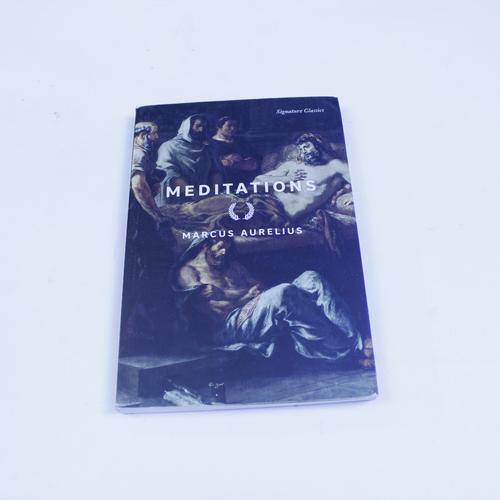

BUY IT NOW : Meditations by Marcus Aurelius Classic Philosophy Book Original English
Stoicism Essential: Meditations by Marcus Aurelius – Definitive Guide to Timeless Stoic Wisdom for Modern Stress and Resilience
Meditations by Marcus Aurelius is not a theoretical philosophy textbook but the private, unedited journal of a Roman Emperor written between 161 and 180 AD while commanding legions on the Danubian frontier. Composed in Koine Greek under the original title Ta Eis Heauton (To Himself), the work consists of 12 books of aphorisms, exercises, and reminders grounded in Stoic practice. For the modern reader facing workplace conflict, digital overwhelm, anxiety, and decision fatigue, this volume provides a field-tested system for emotional regulation, rational action, and inner resilience that has remained relevant for nearly two thousand years.
This specific portable edition is engineered for daily use rather than display. Its compact, durable format is designed to be carried, annotated, and consulted in real-world conditions — on a commute, during a work break, or as a nightly reflection ritual. It preserves the direct, unadorned voice of Marcus Aurelius without academic embellishment, making Stoic discipline immediately accessible.
Historical Context: The Emperor-Philosopher Behind Meditations
Understanding the author is essential to understanding the authority of the text. Marcus Aurelius Antoninus was the last of the Five Good Emperors of Rome, ruling the Roman Empire from 161 AD until his death in 180 AD. Adopted successor to Antoninus Pius, he presided over plague, famine, frontier wars against the Parthians and Germanic tribes, and political betrayal, all while adhering to a rigorous philosophical code.
Stoicism: From Zeno to the Imperial Palace
Stoicism was founded by Zeno of Citium around 300 BC in Athens and further developed by Chrysippus, Epictetus, and Seneca. Unlike Epicureanism or Skepticism, Stoicism is a practical philosophy of action centered on living in accordance with nature, exercising virtue, and distinguishing between what is within our control and what is not. Marcus Aurelius was a direct practitioner of this lineage, studying under the Stoic teacher Junius Rusticus and corresponding with the rhetoric of Epictetus through his Discourses.
Meditations was never intended for publication. The text contains no chapters written for an audience, no rhetorical flourishes, and no attempt to persuade. This authenticity is precisely what gives the work its enduring power. Readers encounter an unfiltered dialogue of a man reminding himself to practice temperance, courage, justice, and wisdom while burdened by absolute power and absolute responsibility. For collectors and students of philosophy, this provenance makes every copy a direct transmission of classical antiquity, not a secondary interpretation.
Structure and Core Doctrine of the 12 Books
The 12 books of Meditations are not chronological or thematic in a modern sense. They are repetitive by design, functioning as spiritual exercises. Key Stoic entities and concepts appear throughout:
- The Dichotomy of Control: The foundational distinction between internal judgments and external events. Marcus Aurelius repeatedly instructs himself that opinion, choice, and character are his alone, while reputation, health, and wealth are external and indifferent.
- Premeditatio Malorum: The premeditation of evils. By anticipating insult, failure, and loss in advance, the Stoic removes their power to shock and destabilize.
- Memento Mori and Impermanence: Constant reflection on mortality and the transience of fame and material possessions to clarify present-moment priorities.
- Amor Fati and Logos: Acceptance of the rational order of the cosmos (Logos) and the conversion of obstacles into fuel for virtue. What stands in the way becomes the way.
- Duty and Cosmopolitanism: The obligation to act for the common good as a citizen of the cosmopolis, or universal community of rational beings, rather than for personal gain.
Secure this item directly from our eBay store
Modern Application: Why Meditations Is a Tactical Manual for Resilience
The value of Meditations is not historical curiosity but operational utility. Unlike modern self-help literature that offers temporary motivation, Stoic practice offers cognitive tools for permanent behavioral change.
Use-Case 1: Managing Difficult People and Professional Conflict
Book 2 opens with the famous reminder: “Say to yourself in the early morning: I shall meet with the busy-body, the ungrateful, arrogant, dishonest, jealous and unsociable.” This is not cynicism but preparation. Marcus teaches that difficult behavior stems from ignorance of the good, not malice toward you. Applying this reframe in a workplace with a difficult coworker, manager, or client allows you to respond with objective analysis instead of emotional reactivity, preserving professional authority and personal peace.
Use-Case 2: Reducing Anxiety, Stress, and Digital Overwhelm
Stoicism directly targets the mechanism of anxiety: judgment. Marcus writes, “If you are distressed by anything external, the pain is not due to the thing itself, but to your estimate of it; and this you have the power to revoke at any moment.” For modern stressors including information overload, financial pressure, and social comparison, the practice is to isolate the bare facts from the narrative added by the mind. The book is structured for micro-reading, where a single passage of two to three sentences can interrupt a spiral of catastrophic thinking and restore rational perspective.
Use-Case 3: Building Discipline, Focus, and Morning Routine
Entrepreneurs, athletes, and military leaders use Meditations as a cornerstone of a daily discipline system. The text advocates for journaling, negative visualization, and voluntary discomfort as training for character. Reading one passage upon waking and one before sleep creates a consistent cognitive anchor, similar to the morning routine used by practitioners of Cognitive Behavioral Therapy (CBT), which draws directly from Stoic techniques developed by pioneers like Albert Ellis and Aaron Beck.
Edition Profile: Physical Specifications and Collector Value
This edition is curated for readers who prioritize portability, readability, and frequent use. While definitive critical editions such as the George Long or Gregory Hays translations serve academic study, this compact volume is optimized as an everyday carry philosophical tool.
| Attribute | Specification |
|---|---|
| Author | Marcus Aurelius (121-180 AD), Roman Emperor |
| Genre / Category | Classical Philosophy, Stoicism, Ethics, Personal Journals |
| Format | Compact Portable Print Edition, Ideal for Commute, Travel, and Nightstand |
| Language | English Translation of Koine Greek Original – Direct, Plain, Aphoristic Prose |
| Content Focus | Personal philosophy, self-discipline, and thought management; minimal historical narrative |
| Ideal Placement | Daily reference library, nightstand, office desk, carry bag |
Beyond its practical use, Meditations holds permanent collector and library value. As one of the three canonical pillars of Roman Stoicism alongside the Discourses of Epictetus and the Letters to Lucilius of Seneca, it is a foundational text for any serious philosophy, classics, or leadership collection. Unlike trend-driven productivity books, its intellectual status has appreciated continuously for two millennia and remains a required text in university ethics, military academies, and executive leadership programs.
The Tactile Advantage: Why a Physical Copy Outperforms Digital
Owning a physical copy of Meditations creates a psychological commitment device. The act of physically opening the book, underlining a passage, and placing it visibly in your environment transforms abstract philosophy into an embodied habit. Digital files are consumed and forgotten; a tactile volume on a nightstand serves as a persistent visual cue to pause, reflect, and recenter before reacting. This analog interaction is central to the Stoic exercise of attention (prosoche), training sustained focus in an age of distraction.
For gifting, this edition functions as a high-signal present for graduates, professionals entering leadership, or anyone navigating transition, grief, or high-pressure decision-making. It communicates substance and longevity rather than novelty.
Check current availability on eBay now
Answers & FAQs
Is this edition of Meditations suitable for a complete beginner with no background in philosophy?
Yes, this edition is specifically accessible for beginners because Marcus Aurelius wrote in short, direct personal reminders rather than complex academic arguments. You can open to any page and extract a complete, actionable insight without needing to read sequentially or understand prior philosophical systems.
How does this portable edition differ from larger annotated academic translations?
This portable edition prioritizes readability and daily carry over extensive footnotes, scholarly introductions, and critical apparatus. It delivers the core text in clear, plain English for immediate practical application, while academic editions are designed for linguistic and historical research.
How long does it take to read and how should it be used for stress management?
While the full text can be read in a few hours, its intended use is not linear reading but daily, iterative reflection on one to two passages at a time. Many readers use a 5-minute routine of reading a single meditation in the morning and journaling a response in the evening to build resilience over time.
Is Meditations a religious text and is it compatible with modern belief systems?
No, Meditations is a secular, rational philosophy of ethics and not a religious doctrine tied to any deity, dogma, or ritual. Its principles of virtue, rational control, and service to the common good are fully compatible with all modern faiths and secular worldviews.
BUY IT NOW : Meditations by Marcus Aurelius Classic Philosophy Book Original English
Get AI Tools
Openwork – Free AI Helper https://openworklabs.com/
HyNote – AI Notetaking https://hynote.ai/?via=MGZFMA83PH
Rokid Glasses : https://rokid.sjv.io/1Gz3G9