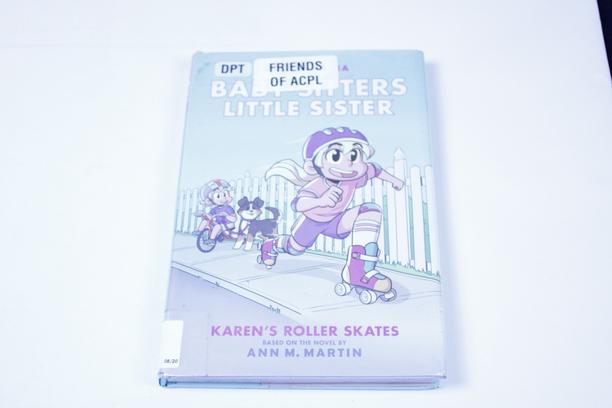

BUY IT NOW : Karen’s Roller Skates Baby-sitters Little Sister Graphic Novel by Ann M.
Karen’s Roller Skates Baby-sitters Little Sister Graphic Novel Essential: Karen’s Roller Skates by Ann M. Martin – Definitive Collector’s Guide and Review
Karen’s Roller Skates is the second volume in the Baby-Sitters Little Sister Graphix series, adapting Ann M. Martin’s classic 1989 prose novel for a new generation of readers through the Scholastic Graphix imprint. While the main Baby-Sitters Club focuses on Kristy Thomas and her brigade of teenage entrepreneurs in Stoneybrook, Connecticut, this spin-off centers exclusively on Kristy’s seven-year-old stepsister, Karen Brewer, a character defined by her dual-household dynamic and outsized personality. This graphic novel adaptation preserves the core emotional architecture of Martin’s original narrative while deploying sequential art to amplify accessibility, nostalgia value, and collectibility. For collectors, educators, and parents, understanding its place within the broader Baby-Sitters Club media ecosystem is essential to evaluating its long-term shelf value and reader utility.
Who Is Karen Brewer? Entity Profile Within the Stoneybrook Universe
Karen Brewer is the younger stepsister of Kristy Thomas and the biological daughter of Watson Brewer and Lisa Engle. Her character canon is defined by a bi-local family structure: she alternates between the “big house” with her father Watson, stepmother Kristy’s mother Elizabeth Thomas-Brewer, and blended siblings, and the “little house” with her mother Lisa and brother Andrew. This dual-residence framework is central to the Baby-Sitters Little Sister continuity, which ran as a standalone prose series from 1988 to 2000 with 122 titles. Karen is characterized as a second-grader at Stoneybrook Academy, notable for her signature accessories, including her distinctive glasses, her love of the color purple, and her self-appointed role as a “professional” despite her age. In Karen’s Roller Skates, these traits converge around her desire for autonomy and status among peers, making the book a definitive character study rather than a simple episodic adventure.
Plot Architecture: The Narrative Engine of Karen’s Roller Skates
The narrative of Karen’s Roller Skates operates on a classic childhood conflict: aspiration versus restriction. Karen desperately wants a pair of modern roller skates after observing her friends skating with skill and freedom. Her parents initially refuse, citing safety concerns and cost, which triggers Karen’s signature response pattern of persuasion, negotiation, and eventual compromise. When she finally acquires the skates, the story pivots from acquisition to consequence, as Karen must learn practical skills, manage physical risk, and navigate peer dynamics on the rink and sidewalk.
Core Thematic Conflicts
- The Independence Dialectic: Karen’s push for adult-like freedom is contrasted with age-appropriate safety boundaries set by Watson Brewer and Lisa Engle. The skates function as a tangible symbol of growing up.
- Peer Validation and Social Capital: The acquisition of roller skates is tied to belonging. Karen equates the equipment with inclusion in her friend group at Stoneybrook Academy.
- Mishap and Accountability: The plot includes a distinct inciting incident where Karen’s enthusiasm outpaces her ability, leading to a fall and a lesson in perseverance and responsibility rather than punishment.
- Blended Family Logistics: The story subtly reinforces how Karen transports possessions and experiences between two households, a relatable logistical reality for readers in shared-custody families.
Unlike anthology-style graphic novels, this volume delivers a self-contained narrative arc with a clear beginning, climax, and resolution. Readers do not require prior knowledge of Karen’s Witch or Karen’s Worst Day to achieve full comprehension, though sequential reading enhances character continuity.
Original Novel vs. Graphix Adaptation: Critical Distinctions for Collectors
The 1989 prose edition of Karen’s Roller Skates by Ann M. Martin was illustrated with sparse black-and-white line drawings by Susan Tang. The Graphix adaptation, published July 7, 2020, is a full-color reinterpretation written by Ann M. Martin and illustrated by Katy Farina. Farina, also the artist for Karen’s Witch, Karen’s Worst Day, and Karen’s Kittycat Club, reimagines the Stoneybrook aesthetic with expressive character acting, dynamic motion lines for skating sequences, and a pastel-forward palette optimized for readers ages 6-10.
Key adaptation differences include expanded visual gags, condensed internal monologue rendered as thought bubbles, and the translation of descriptive prose into background detail. For collectors, the Graphix edition is not a replacement for the first-edition prose novel but a parallel collectible within the Scholastic Graphix reboot continuity that began in 2019. The Graphix line has significantly revitalized the franchise, introducing the Baby-Sitters Little Sister brand to the graphic memoir market dominated by titles like Raina Telgemeier’s Smile and Dav Pilkey’s Dog Man.
Secure this item directly from our eBay store
Technical Specifications and Collector Data Sheet
| Attribute | Specification |
|---|---|
| Full Title | Karen’s Roller Skates: A Graphic Novel (Baby-Sitters Little Sister #2) |
| Creator Credits | Written by Ann M. Martin, Illustrated by Katy Farina |
| Publisher / Imprint | Scholastic Inc. / Graphix |
| Publication Date (Graphix Edition) | July 7, 2020 |
| Format | Paperback Graphic Novel, Full-Color |
| Page Count | 144 pages |
| ISBN-13 | 978-1338305151 |
| Product Dimensions | 5.5 x 0.5 x 8 inches |
| Reading Level | Ages 6-9, Grades 1-4, Lexile GN410L |
| Genre / BISAC | Juvenile Fiction / Comics & Graphic Novels / Family / School |
| Series Position | Book 2 of 5 in the Baby-Sitters Little Sister Graphix series |
| Language | English |
Art Style and Visual Literacy Benefits
Katy Farina’s illustration methodology employs clean linework, large panel gutters, and emotive facial coding to scaffold reading comprehension for emerging readers. Motion is conveyed through repeated figures and speed lines during skating sequences, teaching visual causality without dense text blocks. The color scripting uses distinct palettes to differentiate the “little house” and “big house” environments, reinforcing Karen’s dual-world navigation for visual learners.
For educators and literacy specialists, this structure delivers measurable benefits. The ratio of image to text reduces cognitive load for reluctant readers while maintaining narrative complexity. Dialogue-driven panels support sight-word retention and fluency, and the sequential format trains inference skills as readers bridge action between panels. The book is frequently deployed in second and third-grade classroom libraries as a high-interest, low-frustration bridge between picture books and chapter books.
Collector Value, Condition, and Market Positioning
The Baby-Sitters Little Sister Graphix series maintains strong aftermarket velocity due to Scholastic’s institutional distribution and the enduring cross-generational equity of the Baby-Sitters Club intellectual property. Karen’s Roller Skates is not a limited edition, but its value is determined by condition, printing, and completeness.
- First Printing Identification: First printings state “First printing, June 2020” on the copyright page with a full number line 10 9 8 7 6 5 4 3 2 1. Later printings show truncated number lines.
- Condition Grading: Collectible value requires evaluating spine stress, corner bumps, color fading on the predominantly pink and teal cover, and interior page toning. New, unread copies with no remainder marks command premium pricing.
- Series Completeness: Value compounds when offered as a contiguous run with Karen’s Witch (Book 1), Karen’s Worst Day (Book 3), Karen’s Kittycat Club (Book 4), and Karen’s School Picture (Book 5).
- Nostalgia Arbitrage: Adult collectors who owned the 1989 prose original drive demand for Graphix adaptations to share with their own children, creating a dual-audience market that sustains resale liquidity.
As Scholastic Graphix continues to expand the catalog, early volumes like Karen’s Roller Skates establish foundational scarcity. Copies retained in near-mint condition are positioned to appreciate as the franchise approaches its 40th anniversary.
Ideal Reader Use-Cases and Acquisition Rationale
This volume serves four distinct acquisition profiles. For independent readers ages 6-10, it offers a protagonist who mirrors their own social and familial challenges, validating feelings of frustration and ambition. For reluctant or struggling readers, the graphic novel format provides an on-ramp to sustained reading stamina without sacrificing story. For parents and gift-givers, it functions as a screen-free, high-engagement property with positive behavioral modeling around persistence and apologizing after mistakes. For Baby-Sitters Club completists, it is a non-optional canonical bridge that documents Karen Brewer’s evolution from supporting character to franchise lead.
Classroom utility is equally specific. The book supports units on family structures, character traits, and problem-solution narrative mapping. Its Lexile measurement of GN410L aligns with guided reading levels L-M, making it assignable for differentiated instruction. The self-contained plot allows for single-session reading assignments or book-club discussion without requiring multi-book commitment.
Answers & FAQs
Is Karen’s Roller Skates by Katy Farina a faithful adaptation of Ann M. Martin’s original 1989 novel?
Yes, the Graphix edition retains the central plot of Karen lobbying for and learning to use roller skates, including the core family dynamics and mishap. It condenses prose descriptions into visual storytelling and dialogue while preserving all major narrative beats and character outcomes.
What is the precise reading level and age range for Karen’s Roller Skates graphic novel?
The publisher designates the book for ages 6-9 and grades 1-4, with a Lexile measure of GN410L and guided reading level L-M. It is specifically engineered for emerging independent readers and transitional graphic novel readers.
How does this book connect to the main Baby-Sitters Club graphic novels by Raina Telgemeier and Gale Galligan?
Karen’s Roller Skates exists in the same Stoneybrook continuity but focuses on Karen Brewer’s second-grade experiences rather than the teenage babysitting business. It is part of the Baby-Sitters Little Sister spin-off line and can be read independently of the 14-volume main Baby-Sitters Club Graphix series.
Is this graphic novel a complete story or does it require purchasing other books in the series?
This volume presents a complete, self-contained story with a resolved arc concerning the roller skates from desire to mastery. No cliffhanger requires immediate purchase of the next volume, though character development continues across the series.
For collectors seeking a pristine, photo-verified copy with intact color fidelity and uncreased spine, sourcing from a dedicated seller ensures condition accuracy and protected packaging. Inventory for high-demand Scholastic Graphix titles fluctuates with school-year purchasing cycles, making timely acquisition critical for gift and classroom deadlines.
Check live availability and secure this collector’s copy on eBay
BUY IT NOW : Karen’s Roller Skates Baby-sitters Little Sister Graphic Novel by Ann M.
Get AI Tools
Openwork – Free AI Helper https://openworklabs.com/
HyNote – AI Notetaking https://hynote.ai/?via=MGZFMA83PH
Rokid Glasses : https://rokid.sjv.io/1Gz3G9