
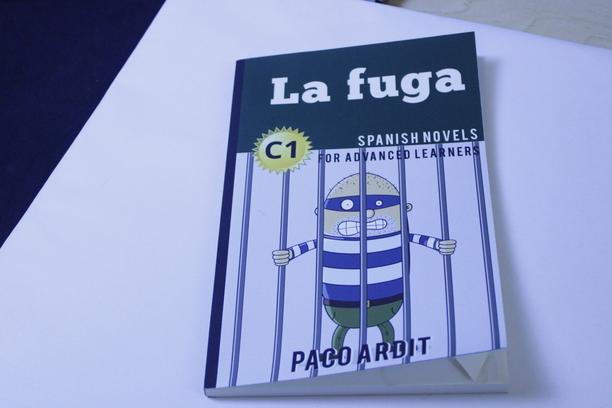

BUY IT NOW : La Fuga C1 Level Spanish Language Learning Book by Author Paco Ardit Novel
La Fuga C1 Spanish Thriller Essential: La Fuga by Paco Ardit – Definitive C1 Review and Advanced Fluency Guide
La Fuga by Paco Ardit is a C1-level Spanish graded reader engineered for advanced learners operating at the Proficient User threshold of the Common European Framework of Reference for Languages (CEFR). Unlike adapted classics or simplified translations, this title is an original thriller narrative constructed from the ground up with C1 lexical fields, complex syntax, and idiomatic authenticity. For learners transitioning from B2 upper-intermediate to C1 effective operational proficiency and C2 mastery, La Fuga functions as a critical extensive reading instrument that delivers comprehensible input without sacrificing narrative velocity or literary tension.
This definitive guide analyzes the linguistic architecture, pedagogical utility, and collector profile of Paco Ardit’s advanced Spanish thriller. It establishes why this specific edition is an essential acquisition for DELE C1 candidates, self-directed polyglots, and university Spanish programs seeking high-retention reading material.
What Is La Fuga? A C1 Graded Thriller Built for Fluency
La Fuga translates to The Escape, and the narrative delivers a high-stakes, psychological thriller centered on confinement, pursuit, and the universal drive for freedom. The text is not a bilingual edition or a side-by-side translation. It is a monolingual Spanish graded reader where meaning is acquired through contextual inference, supported by targeted glossaries and lexical notes. This methodology aligns with Stephen Krashen’s Input Hypothesis, where acquisition occurs when learners are exposed to language slightly above their current level (i+1) within a compelling, low-anxiety context.
At the C1 level, graded readers diverge significantly from A1-B2 materials. While lower-level readers restrict verb tenses to presente, pretérito perfecto, and pretérito indefinido, La Fuga deploys the full spectrum of advanced Spanish grammar. Readers encounter extensive use of the subjunctive in nominal, adjectival, and adverbial clauses, the conditional perfect (habría fugado), passive voice with ser, future perfect, and nuanced applications of por versus para. The narrative voice shifts between pretérito imperfecto for background description and pretérito indefinido for foregrounded action, training the reader to process aspectual distinctions in real time.
Paco Ardit: Architect of CEFR-Aligned Extensive Reading
Paco Ardit is a recognized entity in the Spanish as a Foreign Language (ELE) publishing ecosystem, specializing in original graded fiction stratified across CEFR levels A1 through C2. His bibliography includes more than 30 titles, each calibrated to a specific lexical headword count and grammatical inventory. Unlike publishers who retrofit existing literature, Ardit authors original plots calibrated for vocabulary frequency lists derived from the Plan Curricular del Instituto Cervantes.
The pedagogical value of an Ardit text lies in its consistency. Each C1 installment maintains a controlled vocabulary of approximately 3,000-3,500 active headwords, with systematic recycling of low-frequency lexemes, colloquialisms, and phraseological units (locuciones). For La Fuga, this includes advanced vocabulary domains related to the thriller genre: legal and carceral terminology (fianza, condena, coartada), psychological states (angustia, desasosiego, recelo), and tactical language of evasion (rastrear, escondite, chantajear).
CEFR C1 Linguistic Specifications: What Defines Advanced Proficiency
The C1 level, defined by the Council of Europe as Effective Operational Proficiency, requires the learner to understand a wide range of demanding, longer texts and recognize implicit meaning. La Fuga is engineered to meet these exact descriptors through its linguistic architecture.
| Specification | Detail for La Fuga C1 Edition |
|---|---|
| Author | Paco Ardit |
| CEFR Level | C1 – Effective Operational Proficiency (Proficient User) |
| Genre | Contemporary Thriller / Psychological Suspense / Escape Narrative |
| Language | Peninsular Spanish with universal Hispanophone applicability |
| Lexical Support | In-chapter glossaries, footnotes for idiomatic expressions, and end-of-book vocabulary lists |
| Grammatical Focus | Subjunctive, conditional structures, passive constructions, complex subordination, idiomatic periphrases |
| Format | Standalone thriller; part of the Paco Ardit CEFR-graded collection |
| Ideal User | DELE C1 candidates, university ELE students, advanced autodidacts, heritage speakers |
Where B2 readers explicitly teach connectors such as sin embargo and por lo tanto, La Fuga assumes mastery of those discourse markers and introduces advanced cohesive devices: no obstante, con todo, pese a que, dado que, en aras de. The text also saturates the narrative with collocations and verbal periphrases (echar a perder, llevar a cabo, dar con) that are critical for achieving native-like selection at the C1-C2 boundary.
Inside the Narrative: Tension, Mystery, and Thematic Depth
The plot of La Fuga operates as a sustained exercise in suspense linguistics. The protagonist is entangled in a high-stakes escape scenario where every interaction carries subtext and every chapter ends on a narrative cliffhanger designed to drive extensive reading. The thematic core explores institutional power, personal autonomy, and moral ambiguity, providing rich material for inferencing implicit meaning, a core C1 reading competency.
From an information-gain perspective, thriller fiction offers distinct advantages for advanced acquisition. Dialogue is rapid, elliptical, and rich in pragmatic markers of doubt, irony, and evasion. Narrative description employs precise, sensory adjectives and metaphorical language absent from instructional texts. This duality trains two separate C1 skills simultaneously: processing interactional spoken Spanish and decoding abstract, literary written Spanish.
Secure this item directly from our eBay store
Advanced Fluency Guide: How to Extract Maximum Value from La Fuga
To convert this thriller from passive reading into active fluency development, apply a structured extensive reading protocol rather than intensive dictionary translation.
1. The Context-First Protocol
Resist the urge to interrupt reading for every unknown term. Ardit’s glossary is curated to define only those low-frequency items that cannot be inferred from context. Mark unknown words with a pencil and deduce meaning from collocational and syntactic environment before verifying in the glossary. This strengthens lexical inferencing, a skill directly tested in DELE C1 reading comprehension.
2. Shadowing and Prosody Training
Read dialogue passages aloud. C1 thriller dialogue contains hesitation phenomena, interruptions, and discourse particles (bueno, vamos, mira) that are essential for oral fluency and listening comprehension. Recording and comparing your prosody to internal native-speaker models builds phonological control.
3. Syntactic Harvesting
Maintain a dedicated notebook for complex sentence mining. Extract five sentences per chapter that contain a subjunctive trigger, a concessive clause, or an idiomatic expression. Rewrite the sentence with a different subject or context. This technique transforms input into productive grammatical competence.
4. DELE C1 Task Transfer
Use each chapter as a prompt for C1 productive tasks. Summarize the chapter in 150 words using nominalization and passive structures. Formulate hypotheses about character motives using conditional perfect and imperfect subjunctive (Si hubiera…, habría…). This mirrors the integrated tasks of the DELE C1 prueba de expresión e interacción escritas.
- Vocabulary Acquisition: Acquire 300-400 new advanced lexemes in context versus 50-80 from equivalent time spent on flashcard drilling.
- Reading Stamina: Build the capacity to process 2,500-3,500 word texts without fatigue, the exact length of DELE C1 source texts.
- Idiomatic Competence: Internalize 50+ locuciones verbales and refranes that distinguish C1 speakers from B2 speakers.
- Motivational Retention: Replace task-based attrition with narrative-driven habit formation, increasing weekly Spanish contact hours.
Collector Value and Library Placement
For collectors of ELE materials and institutional libraries, Paco Ardit C1 editions represent a stable, high-utility asset. Unlike textbooks that become obsolete with curriculum revisions, graded fiction retains perpetual relevance. The physical edition of La Fuga is characterized by durable paperback binding, clear typography optimized for extended reading sessions, and integrated learning apparatus that eliminates the need for supplementary dictionaries.
As part of a leveled collection, La Fuga holds specific value for completing a CEFR-graded library. Learners who have progressed through Ardit’s A2, B1, and B2 titles achieve measurable continuity when advancing to this C1 text, as the authorial voice and support apparatus remain consistent while linguistic complexity scales predictably. For educators, owning the physical copy enables classroom lending, extensive reading program integration, and reproducible vocabulary assessment.
The intersection of entertainment and advanced pedagogy makes this edition a practical investment for any serious Hispanophile. It eliminates the false dichotomy between studying Spanish and enjoying Spanish.
Claim your C1 copy from our eBay listing before this edition sells out
Answers & FAQs
How does La Fuga align with official CEFR C1 descriptors for reading?
La Fuga aligns directly with C1 descriptors by requiring readers to process long, complex texts, recognize implicit attitude, and infer meaning from idiomatic usage without reliance on translation. The text assumes mastery of B2 discourse markers and systematically introduces C1-level subordination, nominalization, and low-frequency vocabulary.
What grammatical and lexical density separates La Fuga from B2 graded readers?
La Fuga deploys a full range of subjunctive, conditional perfect, and passive constructions alongside advanced connectors such as pese a que and no obstante, which are restricted in B2 texts. Lexically, it introduces approximately 1,000 additional headwords beyond B2, focusing on abstract, legal, and psychological domains with extensive collocations.
Is La Fuga effective as a preparatory text for the DELE C1 examination?
Yes, La Fuga is highly effective for DELE C1 preparation because its chapter length and inferencing demands mirror the Prueba de comprensión de lectura. Regular extensive reading with this text builds the reading speed, implicit comprehension, and sophisticated vocabulary required for the exam’s integrated tasks.
What specific learning support is included in this edition of La Fuga?
This edition includes in-text footnotes for idiomatic expressions and culture-bound terms, plus chapter-specific glossaries and a consolidated end-of-book vocabulary list. These supports are monolingual Spanish definitions designed to maintain immersion while ensuring precise comprehension of advanced terms.
BUY IT NOW : La Fuga C1 Level Spanish Language Learning Book by Author Paco Ardit Novel
Get AI Tools
Openwork – Free AI Helper https://openworklabs.com/
HyNote – AI Notetaking https://hynote.ai/?via=MGZFMA83PH
Rokid Glasses : https://rokid.sjv.io/1Gz3G9
Leave a Reply
You must be logged in to post a comment.