
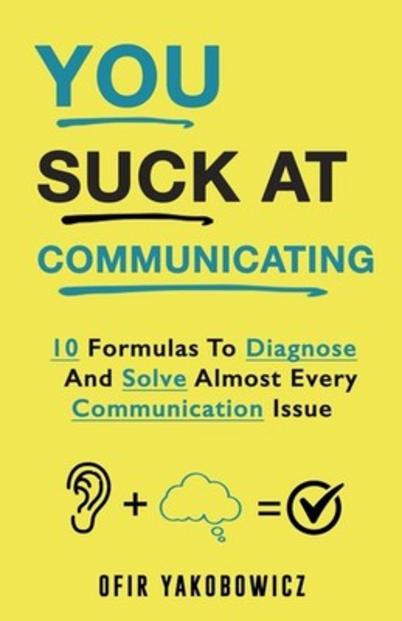

BUY IT NOW : You Suck At Communicating by Ofir Yakobowicz Communication Skills Professional
Communication Skills Essential: You Suck At Communicating by Ofir Yakobowicz – Definitive Practical Guide to Clear Communication at Work and Home
Communication Skills Essential: You Suck At Communicating by Ofir Yakobowicz is a direct, high-impact manual for interpersonal effectiveness designed to correct the silent habits that create misunderstanding in professional and personal environments. Unlike abstract communication theory, this book functions as a diagnostic toolkit for identifying where your message breaks down, why listeners disengage, and how to restructure your delivery for clarity, empathy, and influence. It addresses the core deficit in modern interaction: the assumption that intent equals impact. For professionals, partners, parents, and team leaders who leave conversations feeling unheard or frustrated, this guide provides the missing operational framework for being understood the first time.
Secure this copy on eBay while available
The Core Premise: Why Good Intentions Create Bad Communication
Ofir Yakobowicz centers the book on a critical insight from behavioral psychology and interpersonal communication studies: most communication failure is not caused by lack of vocabulary, but by unexamined transmission habits. The sender encodes a message through the filters of stress, assumption, cognitive bias, and emotional state, while the receiver decodes it through their own distinct filters of past experience, mood, and attention level. This double-filter effect explains why precise instructions become confused tasks at work and why simple requests at home escalate into conflict.
The book systematically deconstructs the illusion of transparency, a cognitive bias where individuals overestimate how well their internal state is understood by others. Yakobowicz argues that phrases like “I was clear” or “They should have known what I meant” are indicators of low communication accountability. The guide reframes effective communication not as self-expression, but as audience-centered engineering.
Five Self-Sabotaging Habits Exposed in the Book
- Passive Ambiguity: Using vague language, hedging, and incomplete requests that force the listener to guess your true need. Examples include hinting instead of asking and using “maybe” or “try” when a clear commitment is required.
- Defensive Listening Triggers: Phrasing feedback or disagreement in a way that activates the listener’s fight-or-flight response. The book details how accusatory “you” statements and absolute language like “always” and “never” shut down dialogue.
- Nonverbal Dissonance: Creating incongruence between verbal content and body language, tone, facial expression, and timing. Research in nonverbal communication shows over 60% of message meaning is interpreted through these channels.
- Assumption-Based Transmission: Failing to verify comprehension and assuming shared context that does not exist. This is a primary failure point in cross-functional teams, remote work, and intergenerational family communication.
- Emotional Leakage: Allowing unregulated frustration, anxiety, or impatience to contaminate the message structure, leading to tone-based misinterpretation even when words are technically correct.
What Differentiates This Guide From Generic Self-Help Communication Books
The self-help communication category is saturated with titles rooted in motivational theory, including classics like Dale Carnegie’s How to Win Friends and Influence People and Marshall Rosenberg’s Nonviolent Communication. While foundational, those works often prioritize philosophy over immediate execution. You Suck At Communicating occupies a distinct position as a tactical field manual for the post-digital communication landscape.
Published for an era defined by Slack messages, Zoom meetings, hybrid workplaces, and text-heavy relationships, the book addresses the compression and de-contextualization of modern messaging. It does not offer affirmations or abstract principles about “being a better listener.” Instead, it provides sentence-level rewrites, listening protocols, and conversation scripts that can be applied in the next interaction. The writing style is intentionally concise and confrontational, designed to bypass reader resistance and create immediate behavioral awareness. Its value lies in its rejection of academic jargon in favor of direct, observable, and repeatable techniques aligned with principles of emotional intelligence (EQ), active listening, and assertiveness training.
Concrete Frameworks and Skills You Will Master
The guide is structured around actionable modules that build communication competence sequentially. Each chapter isolates a specific failure point and replaces it with a structured alternative.
1. The Clarity Protocol for Requests and Instructions
Learn to formulate messages using the principles of specificity, context, and verification. This includes replacing implicit expectations with explicit outcomes, defining timelines and ownership, and closing the loop with a confirmation check such as “To confirm, you will deliver X by Y, correct?” This framework directly reduces workplace rework and domestic resentment stemming from unspoken expectations.
2. De-escalation and Conflict Resolution Language
Yakobowicz provides a reformulation method for high-stakes conversations. The technique involves shifting from judgment to observation, from blame to need, and from demand to request. Readers learn to deploy I-statements, neutral observations, and calibrated questions that keep the prefrontal cortex engaged and prevent amygdala hijack in both parties.
3. Active Listening as an Operational Skill
Beyond the cliché of “listen more,” the book teaches reflective listening, paraphrasing, and labeling. These are evidence-based techniques used in hostage negotiation and executive coaching to demonstrate comprehension and lower defensiveness. The method trains readers to listen to understand and verify, not to reply.
4. Channel-Appropriate Communication
A critical modern skill is matching the message to the medium. The book outlines decision rules for when to use email versus phone versus in-person dialogue, how to structure digital messages for scanability and tone control, and how to prevent misinterpretation caused by lack of nonverbal cues in text-based communication.
Real-World Application: At Work and At Home
Professional Use Cases
In professional settings, the frameworks translate directly to measurable outcomes. For managers, the Clarity Protocol improves delegation, performance feedback, and meeting efficiency. For individual contributors, the assertiveness and framing techniques enhance upward communication, negotiation, and boundary-setting without damaging rapport. For remote and hybrid teams, the verification and channel-selection strategies reduce the costly delays caused by asynchronous miscommunication. Human resources professionals and team leaders use this guide as a low-cost training resource for onboarding and conflict mediation.
Personal and Family Use Cases
In personal relationships, the same principles resolve chronic patterns of feeling unheard. Couples apply the de-escalation language to discuss sensitive topics like finances, responsibilities, and intimacy without triggering defensive cycles. Parents use the clear-request and active-listening models to communicate with children and teenagers in a way that fosters cooperation rather than resistance. The book’s emphasis on emotional regulation and intent-impact separation is particularly effective for breaking repetitive arguments where both parties feel justified but neither feels understood.
Author Authority and Reader Value
Ofir Yakobowicz writes from a practitioner perspective, prioritizing field-tested utility over theoretical elegance. His direct, conversational authorial voice is a deliberate pedagogical choice that mirrors the communication style he advocates: clear, accountable, and free of unnecessary padding. This makes the material accessible to readers without a background in psychology or communication studies, while remaining substantive enough for experienced professionals seeking a refresher.
The book’s concise format is a strategic advantage. Unlike 300-page treatises that remain unfinished, this guide is designed for single-session completion and repeated reference. Its physical format makes it ideal as a desk reference, nightstand manual, or team resource library addition. For collectors of practical psychology, business communication, and interpersonal effectiveness literature, it represents a modern, applied complement to more theoretical texts on emotional intelligence and organizational behavior. The durability of its advice ensures long-term relevance, as the underlying mechanics of human misunderstanding remain constant despite changing technology.
Product Specifications
| Attribute | Details |
|---|---|
| Title | Communication Skills Essential: You Suck At Communicating |
| Author | Ofir Yakobowicz |
| Genre | Self-Help / Interpersonal Communication / Business Communication / Emotional Intelligence |
| Core Focus | Active Listening, Nonverbal Communication, Conflict De-escalation, Assertiveness, Message Clarity |
| Writing Style | Direct, Conversational, Action-Oriented, Non-Academic |
| Ideal Audience | Professionals, Managers, Couples, Parents, Students, Anyone Seeking Immediate Communication Improvement |
| Format | Concise Practical Guide / Quick-Read Reference Manual |
| Key Benefit | Immediate applicability for workplace emails, meetings, and personal conversations |
For readers who want to stop repeating the same conversational failures and start creating understanding on demand, this book delivers a complete reset. Check current availability on our eBay store
Answers & FAQs
How does this book help if I freeze or ramble during confrontation?
A: The book provides pre-structured scripts and observation-based phrasing that replace emotional improvisation with a clear sentence framework. This reduces cognitive load during stress and prevents rambling or shutdown by giving you an exact starting point.
Does Yakobowicz cover digital miscommunication in emails and messaging apps?
A: Yes, the guide includes specific rules for tone management, structure, and channel selection for text-based communication. It teaches how to add context and verification cues that compensate for the absence of body language and vocal tone.
What makes this different from books on Nonviolent Communication or Crucial Conversations?
A: While those titles focus on empathy models and high-stakes dialogue theory, this book is a concise, blunter tactical manual focused on daily execution. It prioritizes immediate sentence-level corrections and habit interruption over extended philosophical frameworks.
Can this guide improve my ability to be heard in team meetings?
A: Yes, it details techniques for framing contributions with clarity, brevity, and audience relevance to capture attention. It also covers active listening responses that build credibility and encourage reciprocal listening from colleagues.
BUY IT NOW : You Suck At Communicating by Ofir Yakobowicz Communication Skills Professional
Get AI Tools
Openwork – Free AI Helper https://openworklabs.com/
HyNote – AI Notetaking https://hynote.ai/?via=MGZFMA83PH
Rokid Glasses : https://rokid.sjv.io/1Gz3G9