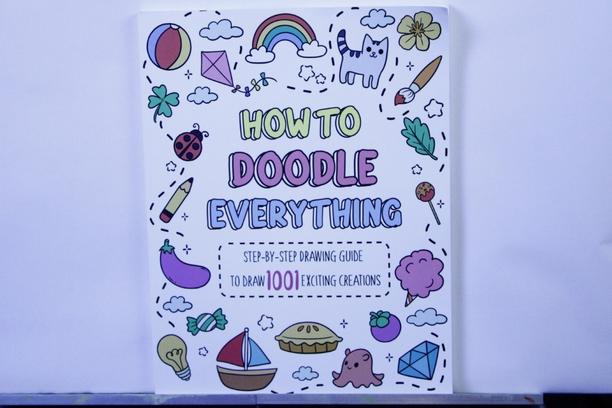

BUY IT NOW : How to Doodle Everything by Draw with Leo Creative Drawing Guide for Beginners
Drawing Guide Essential: How to Doodle Everything by Draw with Leo – The Definitive Beginners Review and Step-by-Step Tutorial Guide
How to Doodle Everything by Draw with Leo is a structured, beginner-centric drawing manual that deconstructs complex illustrations into foundational geometric shapes, sequential strokes, and expressive modifiers. Designed for absolute beginners, this guide eliminates the barrier of perceived artistic talent and replaces it with a repeatable, step-by-step construction system. It functions as a comprehensive visual library for building characters, objects, animals, and scenes from simple circles, ovals, rectangles, and curved lines.
Unlike theory-heavy art textbooks that focus on anatomy, perspective, and shading, this book prioritizes immediate creative output and muscle memory development. Each tutorial is engineered for rapid comprehension and low-friction practice, requiring only a pencil or ballpoint pen and standard paper. For students, hobbyists, journal keepers, and adults seeking a screen-free creative outlet, it provides an accessible framework for developing a personal doodling vocabulary that can be applied to sketchbooks, planners, greeting cards, and visual note-taking.
What Is How to Doodle Everything by Draw with Leo?
This instructional guide is part of the contemporary how-to-doodle genre popularized by social media art educators and platforms like YouTube, Instagram, and TikTok, where the creator Draw with Leo has established an authoritative presence. The book translates the channel’s digital-first teaching methodology into a tangible, analog format. It is not a collection of finished artwork to admire, but a practical workshop manual designed for active participation on every page.
The core premise is that any doodle, from a sleepy cat to an expressive human face or a detailed food item, can be reduced to 3 to 5 simple construction steps. By mastering this modular approach, beginners bypass the frustration of proportion and freehand accuracy and instead learn to assemble images logically. This system builds confidence and retention, enabling users to recreate and remix doodles from memory rather than relying on direct copying.
| Attribute | Specification |
|---|---|
| Title | How to Doodle Everything |
| Creator / Author | Draw with Leo |
| Skill Level | Absolute Beginner to Novice |
| Instructional Method | Step-by-Step Shape Construction (3-5 Steps per Doodle) |
| Core Subjects Covered | Animals, People, Kawaii Food, Everyday Objects, Vehicles, Plants, Emotions & Expressions |
| Required Materials | Standard Pencil, Ballpoint Pen, Eraser, Blank Paper |
| Format | Print Companion Guide for Hands-On Practice |
| Ideal Applications | Art Journaling, Bullet Journaling (BuJo), Visual Notetaking, Mindfulness Sketching, Children’s Art Education |
The Core Pedagogy: The Shape-First Doodling System
The instructional architecture of How to Doodle Everything is built on cognitive chunking and shape language. Instead of presenting a finished doodle as a single, intimidating form, each entity is broken down into its primitive components. This method aligns with how the human brain processes and reproduces visual information most efficiently, making it a highly effective accelerant for beginner skill acquisition.
The 4-Stage Leo Method for Every Doodle
- Stage 1: Foundation Shapes: Every tutorial begins with a primary silhouette using circles, ovals, or rounded rectangles. This establishes correct proportion and placement without pressure for perfection.
- Stage 2: Structural Addition: Secondary shapes are added for limbs, ears, accessories, or defining features. Guidelines ensure symmetry and balance.
- Stage 3: Character Injection: The artist adds facial features, textures, and personality modifiers. This is where a generic shape becomes a distinct character with emotion.
- Stage 4: Outline and Refinement: Construction lines are cleaned up and the final doodle is defined with a confident outline, ready for optional coloring or patterning.
This predictable, repeatable sequence trains hand-eye coordination and visual memory. After completing 20 to 30 doodles, users develop an intuitive understanding of how to construct new, original characters without referencing the book, effectively building a personal visual alphabet.
Inside the Book: A Complete Entity Library for Visual Storytelling
The value of this guide lies in its breadth as a reference library. It does not focus on a single niche but provides a comprehensive taxonomy of doodle entities, enabling users to illustrate entire scenes and narratives. The content is categorized for rapid lookup and thematic practice sessions.
- Animals and Creatures: Step-by-step breakdowns for cats, dogs, birds, sea creatures, forest animals, and fantasy-inspired kawaii creatures. Emphasis on differentiating species through ear shape, tail structure, and snout proportion.
- People and Expressions: Simplified figure drawing for diverse body types, hairstyles, and outfits. A dedicated section on the facial expression matrix teaches how to manipulate eyebrows, eye shape, and mouth curvature to convey over 20 distinct emotions from a base head shape.
- Food and Objects (Kawaii Style): Tutorials for transforming everyday items into characters with faces and personalities. Includes coffee cups, boba tea, fruits, pastries, school supplies, and household objects rendered in the popular Japanese kawaii aesthetic.
- Nature, Vehicles, and Environments: Instructions for plants, flowers, trees, cars, houses, and decorative elements like banners, borders, and speech bubbles essential for journaling and comic-style layouts.
This categorical coverage makes the book a functional toolkit for bullet journal enthusiasts, teachers creating classroom visuals, and content creators needing quick storyboarding assets. Check current availability and secure your copy on eBay to access the full library for immediate practice.
Who Benefits Most From This Beginner Doodle System?
How to Doodle Everything is engineered for specific use-cases where low-intimidation, high-output drawing is required. Its utility extends far beyond casual hobby sketching.
- Absolute Beginners and Self-Identified Non-Artists: Individuals who believe they cannot draw due to lack of formal training. The shape-based method provides verifiable early wins that build momentum and dismantle creative block.
- Parents and Educators: A classroom-ready resource for teaching children ages 8 and up fundamental drawing concepts, fine motor control, and creative storytelling without requiring specialized art supplies or curriculum.
- Mindfulness and Relaxation Practitioners: Doodling is a documented method for reducing cortisol, improving focus during meetings or lectures, and practicing active meditation. The repetitive, structured nature of the exercises promotes a flow state.
- Bullet Journal, Planner, and Scrapbook Users: Users who need to rapidly populate journals with consistent, aesthetically pleasing icons, trackers, dividers, and thematic illustrations. The book provides a reusable inventory of decorative assets.
- Aspiring Illustrators and Visual Note-Takers: Beginners preparing for more advanced illustration, sketchnoting, or UX storyboarding who need to build a foundational visual vocabulary quickly before progressing to perspective and shading.
Why Analog Doodling Outperforms Digital Tutorials for Beginners
While video tutorials offer motion, a physical book provides distinct pedagogical advantages for motor learning. The static, step-by-step format allows learners to proceed at their own pace, linger on difficult steps, and directly compare their work to the reference without pausing or rewinding video. The tactile feedback of pen on paper builds stronger neural pathways for line confidence than stylus on glass.
Furthermore, this guide removes the friction of screen dependency, algorithm-driven distractions, and subscription requirements. It is a permanent, offline resource that can be opened on a desk, annotated, and revisited. The absence of undo functions encourages commitment to lines and teaches learners to creatively incorporate imperfections, a critical mindset shift for developing artistic resilience.
Practical Applications Beyond the Sketchbook
Mastery of the doodles within this guide translates into tangible creative outputs. Users consistently apply the entity library to enhance everyday communication and personal projects.
- Personalized Communication: Create custom greeting cards, gift tags, handwritten letters, and party invitations populated with original characters instead of generic clip art.
- Educational Visuals: Teachers and trainers can transform dry information into engaging whiteboard illustrations, worksheets, and visual study aids that improve student retention.
- Journaling and Memory Keeping: Document travel memories, daily events, and gratitude logs with quick illustrative icons that make journals more engaging and memorable than text alone.
- Early Creative Entrepreneurship: The consistent character style taught in the book provides a foundation for designing stickers, printable planners, and social media content for small shops on Etsy or Instagram.
Condition, Format, and Acquisition Details
This offering is the print edition of How to Doodle Everything by Draw with Leo, presented as a practical, hands-on tutorial companion. As a physical instructional manual, its value is tied to its utility as a working reference that withstands repeated use, page-marking, and desk-side consultation. Unlike ephemeral digital content, a physical copy retains its instructional integrity and becomes a personalized artifact as the owner fills its margins with practice sketches.
For collectors of contemporary how-to-draw literature and practitioners building a permanent creativity toolkit, securing a clean, complete copy ensures uninterrupted access to the full step-by-step curriculum. Proper storage in a dry environment will preserve page integrity for years of reference use.
Answers & FAQs
Is How to Doodle Everything by Draw with Leo effective for adults with zero drawing experience?
Yes, the entire curriculum is architected for zero-experience learners by deconstructing every doodle into 3 to 5 basic shapes like circles and ovals. This shape-first system removes the need for freehand accuracy and allows adults to produce recognizable characters on the first attempt.
What specific drawing styles and themes does the book teach?
The book focuses on the kawaii and minimalist doodle aesthetic, covering over five major themes including animals, human figures with emotion variations, food with faces, everyday objects, and decorative elements. This breadth allows users to combine entities to create complete scenes and illustrated stories.
How does this book differ from watching Draw with Leo on YouTube?
The book provides a curated, sequential, and distraction-free curriculum that can be used offline at any pace, unlike algorithm-driven video feeds. It functions as a permanent quick-reference library where any doodle can be located instantly without searching, pausing, or scrubbing through video timelines.
What supplies are required and can the techniques be used for digital art?
Every lesson requires only a standard graphite pencil, a ballpoint pen or fineliner, and blank paper, with no need for expensive markers or sketchbooks. The shape-construction principles are directly transferable to digital platforms like Procreate, Adobe Fresco, or iPad note-taking apps once mastered on paper.
Ready to transform blank pages into a complete world of characters and stories with a proven, beginner-friendly system? Secure this item directly from our eBay store and begin your guided doodling practice today.
BUY IT NOW : How to Doodle Everything by Draw with Leo Creative Drawing Guide for Beginners
Get AI Tools
Openwork – Free AI Helper https://openworklabs.com/
HyNote – AI Notetaking https://hynote.ai/?via=MGZFMA83PH
Rokid Glasses : https://rokid.sjv.io/1Gz3G9