
Learning a language is one of those things that sounds wonderful in theory and turns painfully ordinary in practice. You buy the app, you swipe the flashcards, you tell yourself that tomorrow you will finally sit down and actually read something in your target language. And then tomorrow comes, and the app badge sits there unopened, and somehow six months have gone by and the only Spanish you can reliably produce is hola and gracias and maybe the occasional muy bien when someone asks how you’re doing. The problem is rarely motivation, honestly. The problem is that most of us got told the wrong story about what language learning is supposed to feel like. We were told it’s about grinding through grammar tables and memorizing verb conjugations until something clicks. But the people who actually get fluent almost always did it the other way around. They fell in love with a story, and the language came along for the ride. That is precisely the philosophy baked into the little gem I want to talk about today, a graded reader called Pasaje de ida by Paco Ardit, and right now it is sitting in the Wiredwizard eBay store at a price that honestly feels like a typo.
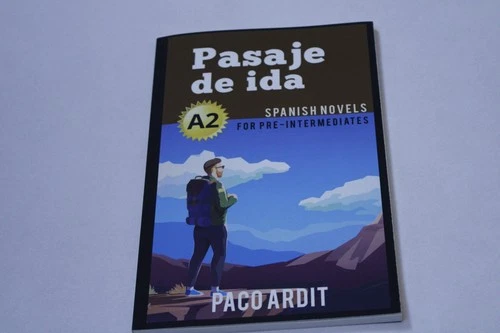
Pasaje de ida is part of a well-loved series of Spanish short stories written specifically for learners, and Paco Ardit has built quite a following by doing something deceptively clever with these books. He writes stories in Spanish that are pitched, deliberately and carefully, at a specific level of comprehension, so that you can actually read them without stopping every twenty seconds to look up a word. The title translates roughly to one-way ticket, and that alone should tell you the kind of story you’re walking into. It’s a narrative about leaving, about movement, about those big life changes that rearrange your whole map. That thematic grounding matters, because a graded reader only works if the story itself is compelling enough to make you forget you’re also doing homework. And this is where Ardit succeeds. The prose never condescends. It’s simplified enough for a learner but written with actual attention to pacing and voice, so you’re pulled forward by the story rather than plodding through an exercise.
Now let’s be honest about what this book is and what it isn’t, because that distinction is the entire reason you’d want it. Pasaje de ida is not a textbook and it’s not a phrasebook. There are no ten-step dialogues for ordering coffee. What it is, is a bridge. It’s the thing that sits between knowing a few hundred isolated words and being able to genuinely read, which is a completely different skill that most self-directed learners never actually build. Reading is the great unglamorous secret of fluency. You can memorize vocabulary until you’re blue in the face, but comprehension is a different muscle, and it only gets trained by doing it. Graded readers exist precisely for that gap. They meet you at roughly your level, stretch you just a little past your comfort zone, and give you the enormous psychological win of finishing an entire story in another language. That feeling, by the way, is addictive in the best possible way. It rewires your whole relationship with the language, because suddenly Spanish isn’t a subject you study, it’s a medium you move through. And once you’ve had that experience once, you’ll chase it again and again with every subsequent book.
The smart approach here is actually pretty simple and it’s worth spelling out because it turns this from a nice-to-have into a genuinely effective tool. Read it with the audio if you can get it, though the book itself stands completely on its own. Read it out loud the first time through, slowly, letting your mouth learn the shapes of the words. Don’t stop to translate every single word into English. That instinct, the one that makes you reach for the dictionary after every third word, is the single biggest thing that kills comprehension progress. Instead, read for the gist. Let the context carry you. Guess, make mistakes, keep going, and then come back and read it again a few days later, when the words that felt impossible have turned friendly. Re-reading is a superpower. The same sentences, the second and third time through, get processed more automatically, and that automaticity is exactly the neurological change that separates a reader from someone who is still laboriously decoding. You’ll be amazed at how much sticks if you just give the story the chance to work on you.
There’s something genuinely charming about the physical object itself too, and I don’t say that lightly about many books. This is a clean, straightforward trade paperback, the kind of thing that travels well, that you can toss in a bag and pull out on the bus or during a lunch break. For something priced at just a hair under five dollars, the expectation might be a flimsy pamphlet, and that’s not what this is. It presents itself as a proper book, with a proper cover and proper pages, which matters more than it should for a learner who is, let’s be honest, already predisposed to treat the whole endeavor as a chore. An object that feels like a real book invites real reading behavior. It sits on your shelf and looks like something you’ll want to finish, rather than like a disposable handout. And this particular copy is brand new, which again, for the asking price, is a pleasant surprise. There’s no wear, no coffee rings, no dog-eared corners from a stranger’s hurried reading. It’s clean and fresh, ready to be the person who actually puts it to work.
The condition detail deserves its own moment, because so much of online book buying comes down to a question we never quite stop worrying about. What am I actually going to get in the mail? When a listing says brand new, and this one does, it carries a specific promise. No bent pages, no scribbled notes in the margins from a previous owner, no spine that’s been cracked open one too many times. For a language learner especially, condition matters in a slightly unexpected way. A scruffy, marked-up copy of a textbook has a kind of lived-in utility, sure, but for a graded reader, the clean state removes every excuse not to start. It arrives looking like a new chapter, literally and metaphorically. And the way Wiredwizard handles the shipping side of that transaction backs up the promise, because these guys clearly understand that the book shouldn’t arrive looking like it went a few rounds first. The packaging is protective, the handling is careful, and shipping is fast, which means the whole experience from click to front door stays pleasant and frictionless.
Let me also push back gently on one hesitation people sometimes have with graded readers, which is the fear that they’re somehow the easy way out, or that reading simplified Spanish is cheating at language learning. That fear is completely backwards, and I want to kill it now. Nobody learns to run by starting with a marathon. Every fluent speaker you’ve ever admired started somewhere short and simple and frankly a little clumsy, and the ones who stuck with it were the ones who found that early stretch of the road genuinely enjoyable. Pasaje de ida is engineered to be that enjoyable stretch. It’s not lowering the bar; it’s meeting you where you are and pushing you forward on a track you can actually stay on. Reading something you can almost fully understand, with a few healthy unknowns sprinkled in, is the sweet spot where acquisition actually happens. It’s the linguistic equivalent of progressive overload in the gym, and it’s how tens of thousands of learners have worked their way steadily up Ardit’s series over the years.
And the pacing of the story itself is honestly satisfying in a way that surprises people. One-way ticket, new city, new start, the familiar drama of a life in transition that spans languages and borders. There’s a warmth to how it unfolds that makes the learning feel secondary to the reading, which is, again, the entire design. You’re not counting down until the chapter ends so you can stop; you’re reading to find out what happens next, and the vocabulary absorption happens almost sneakily while you’re distracted by the plot. That’s the real magic of a well-made graded reader, and it’s worth paying attention to, because it means the effort you put in is compounding. Every chapter builds on the last, and by the final pages you’ll look back at how much more comfortable the language feels than it did on page one. That arc, from tentative to fluent-feeling, is one of the most rewarding experiences self-study has to offer, and it’s all sitting right here for less than the price of a fancy coffee.
When you’re ready, this one’s easy to find. The fast and protective shipping means it’s ready to travel, and the asking price of $4.89 for a brand new copy is the kind of value that makes you wonder where the catch is, only there isn’t one. Whether you’re a complete beginner looking for your first real Spanish read or someone mid-journey who’s stalled out and needs a gentle nudge back into the swing of things, Pasaje de ida is a strong, friendly companion for that road. Head on over to the Wiredwizard store and grab your copy while it’s here, and give yourself the gift of actually finishing a book in Spanish. Trust me, the version of you that closes that last page in a language that used to feel foreign is going to thank the version of you that started.
AI FAQ — Pasaje de ida by Paco Ardit – Spanish Learning
1. What exactly is Pasaje de ida?
It is a graded reader written in Spanish by Paco Ardit, designed specifically for language learners to practice reading comprehension at a level they can genuinely follow.
2. Who is Paco Ardit?
He is a well-known author of Spanish learning materials, particularly the short story graded reader series that Spanish learners use to build and maintain reading fluency.
3. What does the title Pasaje de ida mean?
It translates to one-way ticket, and the story revolves around themes of travel, departure, and new beginnings.
4. Is this book suitable for a complete beginner?
It is best suited to learners with a foundation of basic Spanish, since it is written to be read fairly comfortably rather than decoded word by word, but motivated beginners can work through it with persistence.
5. Can I learn vocabulary purely by reading it?
Reading is an excellent vocabulary builder, though it works best when paired with listening, speaking practice, and consistent re-reading to lock in the words.
6. Is this a traditional textbook?
No. It has no grammar drills or phrasebook-style dialogues; it is a narrative story written with simplified, accessible language.
7. What condition is the copy in the listing?
The copy at Wiredwizard is brand new, meaning clean pages, an intact spine, and no marks or wear from a previous reader.
8. How should I read it to get the most benefit?
Read it in full without stopping to translate every word, aim for the gist, and re-read the book a few days later to build automaticity and comfort.
9. How is the book packaged and shipped?
Wiredwizard uses protective packaging and fast shipping, so the book arrives clean and undamaged.
10. What does the book cost?
It is priced at $4.89, available in the Wiredwizard eBay store.
Buy it on eBay
Get this item now at the Wiredwizard eBay store: this listing on eBay.