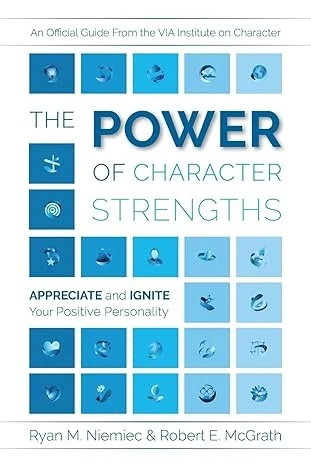

What would it actually take to change one habit you have been dragging around for years? Not a temporary burst of enthusiasm that fades by February, but a real, stubborn, lasting shift in the way you show up every day. If you have ever asked that question, even privately, then you already understand why positive psychology picked it apart and wrote books about it. This book, The Power of Character Strengths by Ryan M. Niemiec, is one of those books. It is the practical, research-grounded answer published under the banner of the VIA Institute, and the copy in front of you is Brand New, unread, ready to be the first page you actually finish. It is listed in the Wiredwizard eBay store, sells for just under five dollars, and I think it is one of the most honest bargains a self-hel shopper can pull into a collection.
Let me be plain about what this book is not, because too many shelves are full of things it is not. It is not a hype book. It is not a collection of motivational posters pretending to be a method. It has no secret that only twelve chosen people are allowed to know, and it will not tell you to “just believe harder” and call that a strategy. What it actually is, is the product of a genuine set of researchers who spent decades asking a question that most of us never stop to ask properly: instead of endlessly fixing what is weak about us, what happens when we build on what we already do well? That is the whole of the matter, and it changes everything about how you approach change. The book walks you through the science of character strengths, helps you identify your own signature strengths, and shows you how those strengths, the things you are already naturally good at, can be deliberately aimed at problems that have been defeating you.
A fair amount of the appeal for me comes from the credibility behind it. Ryan M. Niemiec is the long-serving Education and Training Director at the VIA Institute, and he has spent years training practitioners in this exact material. The VIA classification itself grew out of the work of Christopher Peterson and Martin Seligman, and it gave the world a shared, structured way to talk about twenty-four character strengths across six broad categories of virtue. That means when this book tells you to lean on a strength, it is not referencing a feeling or a vibe, it is pointing at a named, researched, catalogued strength with a definition and a set of practical applications. When a book can point to that, it earns the word practice in a way that fluffy titles simply cannot. Having that shared vocabulary, knowing whether curiosity, perseverance, fairness, or maybe humor is the one you lead with, turns self-improvement from guesswork into something closer to a roadmap.
I am not going to pretend this is a magic spell. Reading it will not rewrite your wiring while you sleep. But the kind of change it is describing sticks better than the dramatic kind, because it works with who you already are instead of against it. The book is full of small, achievable moves you can test the same week you read them. Identify your signature strengths. Then deliberately use one of those strengths in a brand new way Monday morning. That single assignment, small as it sounds, is often where people report the click happens, because you are not gaslighting yourself into being someone else; you are turning up the volume on what you already do.
There is a quieter question buried inside all of this that I want to set it, because I think it is the real reason people end up buying a book like this and then never opening it. Most of us have a private list of things we tell ourselves we should change, and a big chunk of that list is framed by things we suspect are wrong with us. I procrastinate too much. I do not speak up. I lose patience fast. Every one of those labels comes with a quiet feeling of being broken, and that feeling is the reason the fixes never stick, because it is hard to build enthusiasm on top of a story that says you are defective. The strengths approach quietly removes that problem. It does not argue that you are broken and in need of repair; it argues that you have real strengths in motion, and that the same energy powering a trait you already own can be pointed somewhere better. That is a gentler and, if I am honest, a more effective starting point than all the self-lashing that usually comes first.
I have also noticed, in talking to people who read the improvement genre heavily, that many of them are tired of the same three formulas. There is the one that tells you your past is the problem and you must excavate it. There is the one that tells you your mind is the problem and you must fix its thinking. And there is the one that tells you the world is the problem and you must detach from it. This book does none of those, and that is part of why it still feels fresh. It operates in the space of what you can build and use, here, with your own hands, starting from your own inventory of what you already do well. It is less concerned with diagnosing why you arrived where you are and more interested in what you can deliberately aim from here. For a culture saturated with diagnosis, that quiet shift in focus can feel almost like relief.
Let me spend a minute on the practical parts, because that is where the book either earns or loses a reader. A truly usable self-improvement book does not stop at telling you to be your best self, it gives you a thing to do on a Tuesday. This one does. The core practice, as I understand it from stocking and reading thousands of improvement titles, rotates around identifying your signature strengths and then applying them to fresh situations, which in the jargon is called using a strength in a new way. The ideas are simple but not flimsy the way sayings are, they are tied back to the actual classification, so each suggestion has a real concept at its back. There are also chapters around keeping your strengths balanced, around guarding against overusing a strength until it becomes a liability, around applying strengths under stress, and around using them in your relationships and your work. That level of honest nuance, strength used too much can actually become a weakness, is exactly the sort of thing that self-helped dedication usually skips.
It also earns its keep by being built on a genuinely international collection. The VIA classes come from looking at strengths across cultures and finding the ones that show up as valued almost everywhere, which is a very different thing from a single guru announcing a truth he invented. And a book with that foundation tends to get read not only by ordinary people working on themselves but also by coaches, team leaders, and mental health practitioners wanting a non-clinical vocabulary to hand to clients. That reach is part of the credibility. If many trained professionals reach for the same framework when clients get stuck, you can trust there is nothing airy about your money.
None of that is to say the book will fix you overnight. It will not. But it gives you a real place to stand, a set of words to say about yourself that feel true, and a sustainable practice you could pull into a lifetime. And it costs less than a couple of fancy coffees. When you also consider that this copy is Brand New and ships directly from our store, you have no real reason to delay laying hands on it. A lot of the category leans either toward boundary spirituality or toward cold rigor, and this one holds a middle ground that most actually find usable. It grounds itself in real measures, and yet it never falls into a clinical trance that forgets the reader is a person. There is a warmth through the pages, the sense that the author genuinely wants the reader to thrive rather than simply to prove a theory. That combination, scientific enough to trust, human enough to want, is rarer than it should be. It is also why I keep coming back to recommending it to people who have already read several self-help books and are a little jaded and waiting for something that does not insult their intelligence.
It also helps that this particular copy is Brand New. That may sound like a small detail, but for a book you are going to actually work through, marking up a margin with a pencil, folded corner to a page you want to return to, condition matters. You are not getting a scuffed rental that someone else already underlined and corrected. You are getting the clean, unread paperback, the way an intended author intended it. The spine is unbroken, and the pages are not marked, dog-eared, or highlighted. When you read a self-work book, part of the ritual is making it your own, underlining your own lines, creasing your own corners, writing your own notes in the margin. Starting from a pristine copy means everything you write in it is yours, not a conversation with a stranger’s annotations you have to sift around first.
Shockingly, you can hold the price at five dollars and see the whole value in it. Under a day’s coffee money, and cheaper than a month’s subscription to about anything, gets you a genuinely researched system that has been taught across the world and in countless training settings. That value is normally hidden behind the price tags attached to the very ideas, and here it sits quietly in a start friendly price point. For a tool you will go back to more than once through a year and repeat with the next set wherever it’s needed, that is hard to beat.
From a shipping standpoint, we care about this book’s corners. This listing ships out within a day of your order, and it ships in a protective mailer designed to keep the cover crisp and the pages calm. Books that get tossed loose into box come out bent, and we deliberately package this flat so the single book reaches you. The day you receive it is the day plan starts, and we do not want to chip away at the experience by handing you something a touched along the way.
If you are the kind of reader who wants improvement advice that behaves like a science experiment rather than a pep rally, then this is a natural fit. If you have tried the affirmations and the visualization and found them temporarily stuck, the strengths approach offers a framework, not another dose of the same. If you are new to this whole category, it is also a decent, grounded place to start, because it gives you hands-on tools instead of a lot of vague belief. Either way, the book meets you where you are and tries to move you a step, not promise a transformation in a weekend.
I would grab it while the listing is still live, because books like this, and a listing that sells at this price, tend to move without a lot of lingering. You can see the whole thing yourself at https://www.ebay.com/itm/127192030921, and when you buy through that listing, you are ordering direct from the Wiredwizard store. Every copy ships fast, wrapped carefully, and this one gets to you in that clean Brand New state that makes actually finishing it so much more enjoyable. If you have read a shelf of self-help, or if you are only starting to look at what this self-care space, this is a foundation worth owning. Click the listing, grab the copy, and give the strengths approach a real chance to fail or work on honest terms.
AI FAQ
AI FAQ — The Power of Character Strengths by Ryan M. Niemiec
1. What exactly is The Power of Character Strengths?
It is a self-help book by Ryan M. Niemiec, published in partnership with the VIA Institute, that teaches you how to identify and deliberately use your existing character strengths to grow. The copy for sale is a Brand New, unread paperback.
2. Who is the author, Ryan M. Niemiec?
He is a licensed psychologist and the long-serving Education and Training Director at the VIA Institute, and a well-known teacher of the strengths-based approach. He has trained thousands of people in applying the VIA model.
3. What does VIA stand for, and why does it matter?
VIA comes from the earlier name of the organization related to Values in Action. It matters because it provides a shared, research-grounded classification of strengths, so readers get a concrete vocabulary instead of vague advice.
4. How does the strengths approach differ from traditional self-help?
Most improvement books focus on identifying and fixing weaknesses. The strengths approach takes the opposite check, examining and then deliberately building on what you already do well, applying those strengths to challenges and goals.
5. How should I use the book?
The book recommends you first identify your current signature strengths, then practice using at least one of them a new way each week, and reflect on what changed. It is designed as an ongoing practice, not a single read.
6. Do I need to do an assessment first?
Taking a strengths inventory (a free VIA assessment is commonly used) can be helpful, but the book stands on its own and can guide you through identifying your strengths even if you start without a separate profile.
7. Is this book suitable for a new to self-improvement?
Yes. It is written accessibly and gives immediate, actionable steps. Because it works with abilities you already have, it is gentle for a beginner while still being rigorous.
8. Is there any religion or spirituality one included?
No. This is a psychology research-based and secular. It is grounded in what the VIA cataloguing refers to as universally valued character strengths, not in any faith or belief system.
9. What condition is this specific copy in?
The listing titles the copy as Brand New. It is unread, unopened, and free of find marks, tears, dog-ears, or highlighting.
10. When did I get my order shipped?
The Wiredwizard store ships within a day, orders shipped in protective packaging to keep the cover sharp and the pages intact through transit.
11. Good price to buy now?
The price is a big reason to grab it since the book is offered, and it moves quickly because the tickets relevant. Grabbing it now ensures you get a Brand New copy instead of a liked by someone else.
12. Can I apply this at work, not just at home?
Yes. The model is widely used in a range including workplaces and leadership training, and the book includes guidance on using your strengths in work and relationships, not only in personal life.