
If you have ever learned a language as an adult, you know the feeling. You spend weeks drilling flashcards, you memorize the difference between ser and estar until your eyes cross, you can name every item in your kitchen in a second language, and then somebody actually starts talking to you at normal speed and you realize you understand maybe fourteen percent of what is coming out of their mouth. That moment is not a failure of effort. It is the natural result of spending too much time on exercises and not nearly enough time inside the language. You have been building vocabulary in a vacuum, collecting words you have never heard used in an actual sentence by an actual human being, and so when you finally step away from the workbook and into the wild, the language feels like a stranger to you. The way out of that rut is not more flashcards. The way out is more reading, more listening, more living inside the language, even if that means starting smaller than our pride wants us to. This is exactly the problem that the graded reader, a whole genre of books built for people at a specific skill level, is designed to solve, and it is the reason I want to talk about the particular book in front of me today.
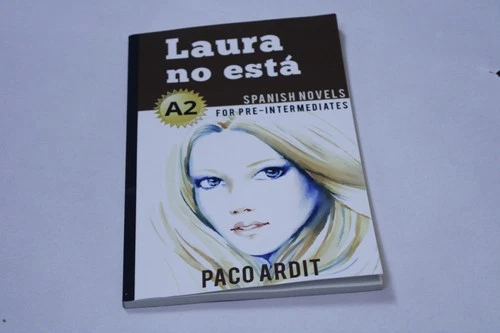
The book I am holding up for you is called Laura No Está, which translates roughly to Laura Is Not Here, and it is one of the entries in a long-running series of graded Spanish novels written specifically for learners. If you are reading this, there is a good chance you have seen this author, Paco Ardit, mentioned in language learning forums, on the reading app recommendations, or in the YouTube comments of some polyglot whose videos you have watched at 1.5 speed while taking notes. His name has become almost synonymous with the phrase graded reader in the Spanish learning world, and the reason is that he built one of the most extensive collections of books designed to sit right at that frustrating gap where you have finished your grammar lessons but you are not ready to read a real novel in the target language. Reading an actual novel at an intermediate level is a miserable experience because you stop every other sentence to look up a word, you lose the thread of the story, and eventually you give up. A graded reader removes that friction by controlling vocabulary and sentence structure so that most of the words are ones you already have, and the story carries you forward without making you reach for a dictionary every minute. It is not dumbing anything down. It is meeting you where you actually are and pulling you toward where you want to be.
This particular copy is listed as brand new, and before you rule it out because brand new feels like it must be an expensive thing, I will point out the price. This seller is offering a novel, sealed, unused, ready for you to read tonight, for a price that is less than what most of us will drop on a single coffee at a corner cafe. You can count on finding plenty of used copies of this exact book floating around, because this series is popular enough that people trade it around when they finish it, but there is something nice about owning a fresh copy that has not been dog-eared yet and that no frantic Scribbled pencil marks, where the spine has never been cracked by an anxious reader in a panic before an exam. If you are someone who collects the books in a language you are studying, the way that a chef collects cookbooks, you know exactly why a fresh copy matters. It is the version you will reach for first, the one that looks the best on the shelf, the one you will pass along or give to a friend when you are finally done with it. Books at this stage of a language journey are workhorses. They get loaned, they get reread, they get scribbled on margins. Starting off with a brand-new one means you get to be the first person to make it your own.
Let me talk about why a story like this, a simple story, actually works better than almost anything else when you are learning a language, and why the investment in this specific thing, a short novel at the A2 level, is one of the most efficient moves you can make. The first and most important reason has to do with what language researchers call input. The modern view of second language acquisition, the view that has basically kicked the old grammar grind approach to the curb, is that humans acquire a language most effectively when they comprehend meaningful messages in that language. In other words, you do not learn a language by memorizing a rule about when to use the subjunctive. You learn it by encountering real, meaningful, understandable chunks of that language, again and again, until your brain starts to absorb the pattern, the same way that a child absorbs the grammar of a native language without ever being handed a grammar worksheet. This is not a fringe idea. It is the whole reason that graded readers and extensive reading programs exist in university language departments around the world. And a book like this one is precisely a delivery vehicle for comprehensible input. It is a real story, with characters and a mystery and dialogue, at just one level beyond your comfort zone. You are not studying this book. You are reading this book. And the entire time your brain is quietly doing the work of acquiring.
That is the theory, but let me talk about the very tangible day-to-day experience. When you sit down with Laura No Está at the correct level, you will find something surprising. You will be able to read pages without reaching for the dictionary every single instance. The sentences are short enough that you can hold them in your head, and the vocabulary is deliberately kept within the commonly used range that an A2 learner is expected to know. There will be some unfamiliar words, because the book is built to introduce a few new ones as it goes, but they will be rare enough that you can guess them from context, which is itself an enormous and wonderful skill in language learning. Guessing from context is how real readers handle real books written in situations they do not fully know, and it is a skill you cannot practice if everything you read is completely easy. This book it sits precisely so that you can feel, for the first time, that you are genuinely reading in Spanish, not decoding it, and that is a transition that flips your entire relationship with the language from studying to living. There will come a moment, probably around the third or fourth chapter, where you are worried about the character in the story rather than worried about the tense of a verb, and that is the exact moment you bought the book for.
Now, a word about level, because A2 might not mean anything to you yet, or you might be wondering whether this is the right level for your situation. The Common European Framework levels, the A, B, C scale, are ways of mapping where you are in a language. An A2 learner is what is often called a way stage or an elementary intermediate. You can handle everyday phrases, you can probably order food, buy things, ask for directions, and you can talk about basic things in the present tense and some in the past. You are past the absolute beginner nonsense of greeting phrases, but you are not yet a comfortable speaker who can jump into a radio show. If that description sounds like you, this book is almost certainly the right fit, and the series even does you the courtesy of organizing its entire catalog by level, so as you finish this one you can confidently reach for the next A2 story and then the next, and then move to the B1 books as you grow. The author has famously kept the books in a continuous shape so that you always know exactly what to read next, which is a huge advantage over a language journey where you turn over and find no road beyond. This book is not a dead end. It is a step on a staircase that extends well into the books you can read when you are done.
There is another thing that makes these books so beloved, and it is fairly simple. They are enjoyable to read. It sounds almost too obvious to be worth saying, but so much practice material for learners is mind-numbing, and there is a reason that most people who start learning a language with a grammar book and a vocabulary app do not last more than a month. Slow learning only happens when a person is actually engaged. This is a story. It is called Laura no Esta, and the very title, Laura Is Not Here, tells you that something is off from page one. Somebody has disappeared, somebody is looking for her, and you are pulled through the pages the way you would be pulled through any mystery, except the maps or the clues are sentences you can actually read. That is the magic trick of a good graded reader. It gets you to forget you are learning only long enough to keep turning the pages, and when you reach the end and set the book down, you catch yourself and realize you have just read an entire novel in Spanish. That is the single most encouraging, self-esteem-building experience available in the whole language-learning season. It reframes what feels like a weakness, realizing you can do it, into a proof of what you can already do.
Now let us get a little more specific about what you will find as you open this book, along in general terms, given that I do not want to spoil the actual story for you. The book is written in a direct, contemporary style, the kind of Spanish that is spoken in everyday life, not the stilted, formal register you find in short textbooks. You will encounter practical verbs, practical phrases, the language of a real daytime life, and you will encounter it in a narrative context that makes it sticky in your memory, because your brain remembers things that happen in stories far better than it remembers matters in a list. The pedagogical design also made this disaggregates the study and the story, keeping vocabulary controlled while never letting paragraphs descend into the mechanical. Because the entire planning of the identity of the book, one idea controls today, and the author has done this kind of thing dozens of times now, there was nothing experimental or risky about it. It is a polished, iteration of a formula that has proven itself over and over with a whole generation of learners. When you buy a book like this, you are not gambling on an experiment. You are buying the well-tested results of a philosophy that has already worked for thousands and thousands of language learners.
Let me talk about combining the reading with other practice, because a book like this is at its best when it is one tool in a bigger plan, and I want to give you a sense of how it might show up in your routine. The best way to use a graded reader is as a sort of foundational text, the thing you actually complete. You can read a chapter and then listen to the audio for that chapter if you have the corresponding audiobook, and let the words wash over you as you look at what you already read. You can make a personal vocabulary list of the handful of new words you see, no more, because at the correct level there should be only a handful, and review that list the next morning. You can even reread chapters you loved out loud, which builds the speaking muscles while forcing your brain to connect the sounds to the words you know. What you should not do is treat the book as a test and get a hold of be missed to a translator. The goal is to get through it fairly naturally, understanding the big picture, feeling confident, and only stopping for a handful of words that genuinely feel important. You would be surprised how much your brain can absorb when you keep a reading flow rather than picking the sentences into a fine dust of translations.
Let me also talk about what this means for your long-term motivation, because I think this is the quiet value of the book that does not fit into a box of a list. Everyone who studies a language has a moment, usually a few months in, where they look up from their desk and realize they have spent many hours and hardly feel anywhere. This despair is not because you have not progressed. It is because progress is invisible when you cannot point at a concrete thing you have never done before. A finished graded reader is that outward-proof. It is a completed novel, an actual book published in the language you are learning, that you have read from the first page to the last. It takes your intangible progress and gives it a weight you can hold and point to. And when you do it again with the next book in the series, and then the next, stack these concrete proofs up, and all of a sudden a strange thing happens. The abstract ambition I am learning Spanish becomes a concrete record of I have read this, this, this, and this. Motivational psychologists talk about how a keystone, small consistent wins build momentum, and a set of graded readers is exactly that, a shelf that visibly builds week by week.
I should mention that this book, because it is from a fast seller and a branded section, makes a really natural gift for someone in your life who is studying Spanish, if that happens to describe one of you of an Aunt or a kid or a coworker who talks about someday. A graded reader is one of the harder gifts to buy for a learner, and a printed physical copy is a lovely thing to hand to a person to something you can write in the inside cover, a little note in Spanish that says a small thing encouraging them. Because the book is brand new, it makes an absolutely perfect, unwrinkled gift for a birthday or a holiday or just a pick me up. It does not need to be wrapped hands and the correct level to make a learning person happy. And if nothing else, the fact that you are here reading about it, that these posts exist at all, tells me you are a person who cares about giving a good book and a good start to a reader, because that is the kind of person these posts are written for.
Let me also address the obvious hesitation a lot of learners feel when they buy a physical book, which is whether they should instead just download a free sum the PDF or read it on an app, and why, the moment you would, it would go the way of a physical copy, this is worth. There is no wrong way to read. Plenty of people will get this exact book on a phone, and good for them. But the physical object has real advantages for a learner. A paper book does not distract you with notifications. It is one thing, and your eyes, and you are not going to tab open to a problem or the grocery store or any of the thousand urgent things skills are always pinging you about. Discretionary readers also find that the tactile motion of turning a page and holding progress in their hands helps the human mind feel the length of the task and stay committed through the whole book. And there is a lovely side-of-a thing. Words you read in physical objects acquire a small layer of memory of where they were on the page and what the book feels like, and that extra form of context is thought to be a small aid for retrieval. So many learners will tell you the physical copy just sticks with them better than was a phone. That is not magic, that is the way brains on the res.
Let me also reassure you about the safety and the appeal if you are buying this as a gift or for yourself new to the whole graded reader, this is about as friendly a place as you can start. Laura No is not a heavy literary novel that is going to demand you parse philosophical paragraphs. It is a manageable, engaging piece of light fiction tuned specifically for an interpreted learner, and that is exactly the point. It will reward you with a completed book and it will not crush you under ambition, which is more than you can say for most serious pieces of student. It fits on a shelf, it fits in a bag, it fits in the time you have. It will be used a good solid hours of reading and it will leave you hungry for the next one in the series. And the fact that we are reading here to you in this room part is a reflection of all the good things this little text stands for. A book like this is the single best money you can spend if you have been circling the idea of actually getting competent in Spanish and have been looking for the thing that picks you all and that gets you all.
So, to bring this all together, the case for this book is the case for the whole idea of reading your way into a language. You have done the flashcard phase, maybe more times than you care to admit, and you are ready to want it done for the real thing, to spend real time inside real sentences that lead somewhere. This book is the perfect first step on a very long and very rewarding climb. It is a new copy, it is at a price you will not have to think twice about, and it is part of a system that will keep handing you the next book when you are ready for it. Right now you can make this very affordable and very smart choice, and you can put yourself, or the learner you love, into the pages of a real novel in the real, actual language. There is not a more motivating thing in the language learning seasons, honestly. Take the leap and read it. You will be surprised how far you get before you even notice you are still learning.
Whether you are starting out, you have been stuck in the low intermediate thread, or you are buying for someone who needs exactly a gentle push into real reading, this is the book. It is a compact, sensible, and absolutely charming step on a staircase most people never actually climb. And climbing it is the point. This story is a small, quiet, paperback, the last surprising thing in the world, and yet it has the power to turn a casual Spanish in all into a someone who realizes they have read an entire book in another language, which is a milestone that nothing else can really give you out of this weight. And that is why I recommended so honestly, and why, a few minutes from now, I suspect you will be glad you clicked through the listing.
AI FAQ
AI FAQ
Q. What kind of book is Laura No Está?
A. It is a graded Spanish reader, meaning a short novel written deliberately with sentence structures and vocabulary suited to a learner at the A2 level of the way to and international Common European Framework. The whole point is that a learner can read a true story without constantly reaching for a dictionary, which is how comprehension grows.
Q. Who is the author, Paco Ardit?
A. Paco Ardit is the author and creator of a large, long-running series of graded Spanish novels aimed at different levels of learners. His series is widely used and well-regarded in the Spanish language learning community, and this book is one entry in that broader system.
Q. What does A2 level mean for a reader?
A. An A2 learner is usually described as a beginner or pre-intermediate, someone who can manage everyday situations, describe familiar topics, order food, and handle the present tense and some simple past for various. It sits after a true beginner and before the comfortable, independent speaker phase.
Q. Is this the right book for a complete beginner?
A. Maybe not. A total beginner who has barely learned any vocabulary would still find it challenging. It’s best matched for it the described as an upper-beginner or low-intermediate, someone who has some basic Spanish under their belt and is ready to attempt reading a real, if simple, book.
Q. Is the copy really brand new?
A. Yes. This particular listing is described as Brand New, meaning it is unused, unmarked, and in the same fresh state as new from the distributor. That is appealing for a reader who wants a clean copy they can personalize, or for giving as a gift.
Q. What should I reasonably expect the level of Spanish to be like?
A. Expect everyday, contemporary Spanish, the kind a normal person would actually speak, written in sentences kept short enough and controlled enough that a learner can follow them. There will be a small number of new words per chapter, but the sentence and structure and core vocabulary is held level to make full reading comfortable.
Q. I am worried I will still need to stop and look up words.
A. You will look up a handful of words, especially at first, but the design implicitly asks to guess at new words from context, and only stop for words that continue to block the meaning. That is a legitimate and excellent reading skill to develop.
Q. How can I get the most value from of reading this book?
A. Read several pages in a comfortable stretch, resist the urge to translate, note a small list of the truly new words, and reread chapters out loud if you can. Consider pairing it with listening practice at the same level if you have access to audio. Do not treat it as a test, focus on flow and confidence.
Q. How long will it take me to finish a book like this?
A. That varies by person and by how much time you to read. For a motivated pre-intermediate, a short graded novel like this is often finished in a few evenings to about a week of casual reading. It is a short story and will not demand weeks of effort.
Q. Can I move to harder books in this series afterward?
A. Yes. This is the deliberate strength of the series. The author organizes the whole catalog by learner level, so after this it is natural to read the next A2 book, then a B1 to B2 series, as you progress. It keeps a clear, encouraging staircase you can advance, a single always knowing what to read next.
Q. Is a printed copy worth it when there are digital versions for free?
A. Many learners find a physical copy removes distractions and helps sustained, focused reading, which is exactly what development needs. You are also supporting a real, unused product and get a copy you can easily pass on in a friend. Both states are valid, but physical has real practical advantages.
Q. Would this make an okay gift for someone studying Spanish?
A. Very much so. Because it is brand new and geared exactly to the pre-mediate learner, it is a thoughtful, low-pressure gift. You can even write a short encouraging phrase in Spanish on the first page to make it personal.
Buy it on eBay
Get this item now at the Wiredwizard eBay store: this listing on eBay.