
Somewhere around the middle of the nineteenth century, a strange and unprompted thought began to occur to the people who ran the world’s biggest empires. The thought was slow to form, reluctant even to be said aloud, but it kept recurring, and it boiled down to this. Our children, and their children, will probably be richer than we are. Not modestly richer, not occasionally richer, but reliably and almost inevitably richer, as if wealth were a force of nature, as if progress were a law of physics as dependable as gravity. That was a genuinely new idea in the history of human affairs. For most of human existence, the opposite had been true. A child was almost certainly going to be poorer than a parent, hungrier, colder, more vulnerable to the same famines and the same plagues that had undone their grandparents. Economic advance was something that happened for a season and then collapsed like a wave. So when progress began to look permanent, when a middle-class family in Manchester or Chicago or Berlin could reasonably assume that their grandchildren would live better than they did, it felt not like good luck but like the natural order of things, like the tide of history had turned and would never turn back. Niall Ferguson, the historian who wrote the book I am about to show you, wants us to look directly at that assumption and ask whether it is still safe to hold.
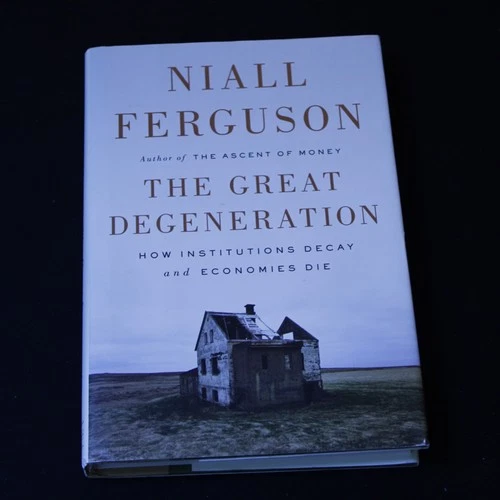
The book is called The Great Degeneration, and its subtitle is far more than a rhetorical flourish. Institutions and the Decline of Nations. That is the entire argument in a single breath. Ferguson’s core claim is that the extraordinary prosperity of the modern West was never the result of accident or geography or luck, and it was certainly not the result of raw greed. It was the product of a particular set of institutional foundations, the very structures that make a complex economy possible. When those foundations function well, they become almost invisible, which is precisely why we stop noticing them. Commerce depends on the steady rule of law and the protection of private property, on contracts that courts will actually enforce, on secure land rights that let people build and invest for the long term, on a legal system that does not bend to the powerful. Finance depends on honest money, on banks and lenders that can trust that they will be repaid and that their claims will be honored. Government depends on constitutional frameworks that check the abuse of power. And Ferguson’s unsettling argument is that, one by one, these western institutional foundations have been quietly eroding for years, being hollowed out from within, while the populations who depend on them go on assuming the structure will hold.
Let me spend a moment on the central metaphor, because it is where the title comes from and it is genuinely powerful. Ferguson borrows a term from the plant sciences to frame his whole case. Aging empires and decaying civilisations, he suggests, can be understood in much the same way biologists understand a tree that has stopped regenerating. A healthy forest, or a healthy civilisation, is not static. It is constantly replacing itself, losing old cells and growing new ones, adapting, renewing, regenerating. When that process breaks down, the organism does not die at once, it keeps standing, it keeps looking, from the outside, like the same grand thing it always was. But underneath, the regeneration has stopped. The tree is hollowing. The civilisation is decaying while it still stands. For Ferguson, the west is living through a great degeneration: a period in which the institutions that once generated wealth and freedom have begun to decay from within, and the decay is remarkably hard to see because the surface still looks intact. The empire still looks like an empire. The wealth still looks like wealth. But the engine that once produced it is running on empty.
Now, I want to be fair here, because this is the kind of book that people can misunderstand if they read only the title. This is not a blast of despair, and it is not the anguished calling of an alarmist who thinks the world is instantly ending. Ferguson is, beneath everything, a historian, which means he thinks in the long arc and in terms of evidence and institutions rather than in terms of dread. He is diagnosing a problem precisely because he believes problems can be addressed. A tree that has stopped regenerating can sometimes be saved, pruned, protected, fed, given the conditions to grow new tissue again. The question his book poses is whether we will bother to do that work, and on what evidence. The Great Degeneration is, at its heart, an argument about the value of the institutions that made the modern world possible, delivered by someone who spent his career studying them, warning them to the returning fragility. It is a book meant to be argued with as much as to be agreed with, which is precisely why it stays alive so long after it first hit the shelves.
Let me situate the book in the wider conversation, because part of its importance is where it stands. The Great Degeneration belongs to a family of big, ambitious, argumentative works that try to explain the rise and the precariousness of western civilisation. Its author is one of the most prominent public historians of his generation, a Cambridge and Harvard-trained scholar who has written sweeping books about the history of money, about the dynamics of empire, about the webs of family and finance that knit the world together, and about the sheer contingency of civilisations that one day seemed unshakeable. A defining feature of Ferguson’s work is its insistence that history is not a story of smooth inevitability but a story of fragile achievements that depend on the continued health of institutions. The Great Degeneration distils that longstanding preoccupation into a tighter, more urgent argument, pulling together themes of law, of finance, of government, and of the ever-present risk of decline. For a reader who wants a clear-eyed, intellectually rigorous, and frankly bracing book that connects economics, history, and the future of institutions, this sits squarely in exactly that literature, and it holds its own among the best of it.
What makes this a book worth actually owning, rather than merely reading about in a review, is that it is the kind of work you return to. It is a book with arguments that reward a second pass, almost friction, where you find yourself putting it down to think, and then picking it back up to argue with the author again. It is short enough, by the standards of heavyweight history, to be read in a focused sitting or two, yet dense enough with ideas to keep furnishing your thinking for years. It is the kind of book you want on the shelf where you can reach it, not because you will read it once and be done, but because every few years, as the news cycle turns back toward the themes of law, money, and institutional health, you will find yourself reaching for it again to see what Ferguson predicted and how it has aged. That is a defining quality of a genuinely great argumentative history: it does not just get read, it gets revisited and re-engaged with. This book earns that kind of rereading, and that is precisely why owning the physical copy feels right.
Let me be honest and precise about the condition of this particular copy, because transparency is the foundation of any good transaction and I will not gloss over it. The listing shows this copy in the condition eBay describes as New (Other). Let me translate that into plain terms, because the label confuses people more than it should. New (Other) means the item has essentially never been used, but it is not being presented in the sealed, pristine packaging of a factory-fresh copy. It might be that the shrink-wrap was opened, or that the book has been stored rather than sold right off the shelf, or that there is some very minor cosmetic detail, maybe a small ding on a corner or a touch of shelf wear, that stops a meticulous grader from calling it Brand New. None of that has anything to do with the book being read or used. The pages are clean, the text is intact, and in every way that matters for a reading experience, this is essentially a fresh copy of a modern history book. If you are someone who does not want to pay the premium that often attaches to a sealed, untouched copy of a big hardcover while still wanting a clean, unread volume, New (Other) is exactly the sweet spot you are looking for.
There is a genuine practical argument to make for buying a clean, sharp copy of a book like this rather than an older, worn one, and it is worth stating plainly. An argument this good deserves to be read in a copy that reads well. A loose, yellowed, dog-eared old library copy, with its spine cracked and its pages foxed and its margins filled with someone else’s inscrutable underlining, is a distraction from the very text you are trying to grapple with. When you are wrestling with a big argument about institutions and the decline of nations, you want clean text and a sound binding from page one. This copy, new in essentially every way that matters, delivers that. It lets the argument do its work uncluttered, which is exactly what a book this intellectually demanding deserves. It also makes it a far better prospect as a gift, should you want to hand it to a clever, curious friend who likes to be challenged, because nobody wants to give a tired, beaten-up book as a gift, while a clean sharp copy feels like the gesture it is meant to be.
I should speak to the price, because it is one of the genuinely pleasant surprises of this listing. This copy of The Great Degeneration is listed at comfortably under five dollars. I want you to read that again and let it land, because it is honestly striking. There are books of comparable intellectual weight and reputation that command a great deal more money, and here is a major work by a world-renowned historian, in essentially new condition, available for what most people spend on a single coffee and a pastry. That price is not a comment on the value of the content, which is substantial. It is simply the market at this moment, and it is very much to your advantage as a buyer. If you have ever put this book on a mental list of things to get around to reading someday, there is no reason for someday to stretch on any longer when the book is sitting here, clean, sharp, and priced like a total steal. This is the rare case where the intellectual value and the asking price are so far apart in your favor that hesitation genuinely makes no sense.
Let me also talk about the getting it to you part, because the practical matters as much as the intellectual on a listing like this. This copy is being offered by the seller Wiredwizard, and the handling is designed around a smooth, trustworthy experience. The shipping is kept prompt, so you are not left waiting endlessly for a book you are eager to dive into, and the item travels wrapped in careful, protective packaging meant to keep it safe and unmarred through the journey. For a book in essentially new condition, arriving intact matters a great deal. Nobody wants a clean sharp copy to show up with corners crushed or a cover scuffed from careless handling. The point of the careful packaging is that the book lands looking exactly the way it does in the listing, clean, straight, ready to be opened. Fast, careful shipping and protective wrapping are the quiet backbone of a satisfying purchase, and they are exactly what this listing sets out to provide.
For whom, then, is this book really meant? Let me try to answer that honestly, because precision here protects both of us from a mismatch. If you enjoy big, argumentative history, if you are interested in the political economy of the modern world, if you have ever wondered why some nations thrive while others stall, or if you simply appreciate a master historian making a bold case with verve and learning, then The Great Degeneration will reward you richly. It is also an excellent companion reading for anyone coming to Ferguson’s larger body of work, a distilled key that gives you the essence of his thinking in a tight, accessible package. If, on the other hand, you are hoping for a dense academic monograph or a conventional, dryly neutral textbook, this may not be your match. This is a book with a point of view, argued forcefully, meant to provoke, meant to be engaged with. That is not a flaw. It is the entire point, and knowing it up front means you can choose it for precisely the right reason.
I want to return, in closing, to the thought I opened with, because it is the emotional and intellectual heart of the whole book. The assumption that our children will be richer than we are was, for a few generations, arguably the strongest unwritten promise the modern west made to its own people. Ferguson’s achievement in The Great Degeneration is to make us see that promise clearly, trace it to its institutional roots, and then ask the question that the book places squarely before every reader: what happens when the institutions that underwrote that promise begin to decay? He does not pretend to have an easy answer, and he does not pretend the decay is not real. What he does, with learning and with conviction, is refuse to let us ignore the question, because a civilisation that does not understand where its prosperity comes from is a civilisation poorly equipped to defend it. That is why this book matters, and that is why owning it, reading it, arguing with it, and keeping it on the shelf to revisit, is genuinely worthwhile.
So here is the whole honest picture before you decide. The Great Degeneration is a major work by one of the most prominent historians of his generation, an urgent and rigorous argument connecting law, finance, and government to the question of how nations decline, offered here in a clean, essentially new copy at a remarkably accessible price. It arrives from the seller Wiredwizard with prompt, careful shipping and protective packaging, ready to become the kind of book you read closely today and reach for again in the years to come. If you have been meaning to engage with Ferguson’s big argument, or if you simply love a sharp, ambitious book of history that grabs you and refuses to let go, there is no reason left to wait. This is the book, and now is the moment to let it find its way into your hands.
AI FAQ — The Great Degeneration
1. What is this book about?
It is a book-length argument by Niall Ferguson that the extraordinary prosperity of the modern west was built on specific institutional foundations, including the rule of law, honest finance, and constitutional frameworks, and that those foundations have been quietly decaying from within while the surface still looks intact.
2. Who is Niall Ferguson?
He is a prominent, Cambridge and Harvard-trained public historian of his generation, known for large, ambitious books about money, empire, family, and the fragility of civilisations. The Great Degeneration distils a lasting preoccupation of his work into a tighter argument.
3. Is this a doom-and-gloom alarmist book?
Not in the sense of breathless dread. Ferguson is a historian who argues with evidence and in the long arc. He diagnoses a real institutional problem, but he does so precisely because he believes such problems can be addressed, and the book is built to be argued with.
4. What does the title The Great Degeneration mean?
Ferguson borrows a biological metaphor from the plant sciences. Like a tree that has stopped regenerating, a civilisation can keep standing and looking unchanged on the surface while the internal mechanism that once produced its strength quietly decays. The west, he argues, is in exactly that process.
5. What are the institutions he claims are declining?
The book focuses mainly on three pillars: the rule of law and protection of property, the honesty and soundness of finance and money, and the constitutional frameworks of government that check the abuse of power. Together these were the foundations of modern western prosperity.
6. What condition is this copy in?
It is listed as New (Other). That means it has essentially never been used but is not in sealed factory packaging. There may be a very minor cosmetic detail such as a small corner ding or shelf wear, but the pages are clean and the book is ready to be read.
7. Is reading this book a serious time commitment?
It is relatively short by the standards of heavyweight history, so it can be read in a focused sitting or two, yet it is dense enough with ideas to keep furnishing your thinking and rewarding rereading for years.
8. Why would this be in essentially new condition and priced so low?
The low price simply reflects the market at this moment, and it works very much in your favor as a buyer. It is an accessible price for a major, intellectually substantial work, with the condition New (Other) describing a clean, unread copy rather than a worn one.
9. Is this book suitable for someone new to economic history?
It is accessible enough for an engaged general reader, because Ferguson writes with clarity and verve for a broad audience rather than a narrow academic one. It works very well as a distilled entry into his larger body of work.
10. How will this copy be shipped?
It is offered by the seller Wiredwizard with an emphasis on prompt shipping and careful, protective packaging, so the book arrives in the clean, straight, unmarred shape that a copy in essentially new condition should.
11. Who would most enjoy this book?
Readers who like big, argumentative history, anyone curious about why some nations thrive while others decline, and students of political economy and institutional change will all find it richly rewarding. It is less suited to someone wanting a dry, neutral textbook.
12. Is The Great Degeneration still worth reading today?
Yes, and in many ways that is its strength. It is built to be revisited, and as the news cycles return to themes of law, money, and institutional health, readers find themselves reaching for it again to see how Ferguson’s arguments have aged, which is exactly the sign of a durable work of history.
Buy it on eBay
Get this item now at the Wiredwizard eBay store: this listing on eBay.