
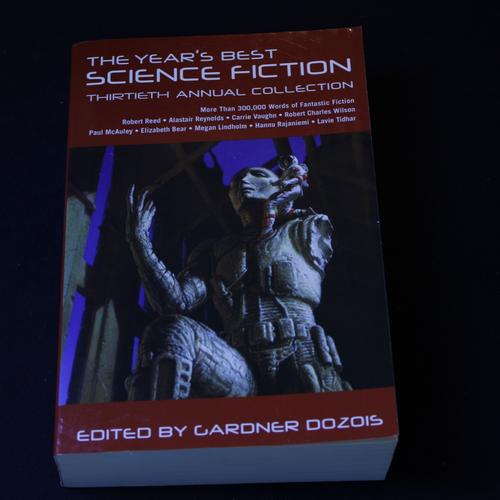

BUY IT NOW : The Year’s Best Science Fiction Edited by Gardner Dozois Anthology Collection
Science Fiction Essential: The Year’s Best Science Fiction by Gardner Dozois – Definitive Collector’s Guide and Complete Review
The Year’s Best Science Fiction edited by Gardner Dozois is the definitive annual anthology series of modern science fiction, published by St. Martin’s Press from 1984 to 2018. Spanning 35 volumes, the series preserved the finest short fiction, novellas, and novelettes originally published in magazines such as Asimov’s Science Fiction, Analog Science Fiction and Fact, The Magazine of Fantasy & Science Fiction, and Interzone, as well as original anthologies. Each volume functions as a curated archive of a single year in the genre, selected by the most awarded editor in science fiction history, with a comprehensive summation of the year’s publishing landscape and an honorable mentions list that tracks every notable story from that period.
For readers and collectors, a volume of Dozois’s Year’s Best represents more than an anthology. It is a filtration system for quality in a field that produces thousands of short stories annually. Dozois read every professional science fiction publication cover-to-cover, evaluating for literary craftsmanship, scientific plausibility, and conceptual impact before selecting approximately 20 to 30 stories representing the absolute peak of that year’s output. This meticulous editorial process ensures that owning a volume provides immediate access to Hugo Award, Nebula Award, and Locus Award-winning fiction without acquiring dozens of back-issue magazines.
Who Was Gardner Dozois and Why His Curation Defines Modern Science Fiction
Gardner Dozois (1947-2018) served as editor of Asimov’s Science Fiction Magazine from 1984 to 2004, winning the Hugo Award for Best Professional Editor 15 times, more than any other editor in history. His influence extended beyond that role through his work as a writer, winning two Nebula Awards for his own fiction, and as the architect of the modern Year’s Best anthology format. Under his stewardship, the series became the standard against which all other best-of-the-year collections are measured.
Dozois possessed an encyclopedic knowledge of the genre’s history and a precise definition of science fiction as literature of ideas grounded in scientific extrapolation. His introductions and summations at the beginning of each volume provide a detailed market report on the state of science fiction: which magazines thrived, which publishers launched new imprints, which subgenres rose or receded, and which authors broke out. For scholars, new writers, and serious fans, these summations alone constitute a primary historical document of the genre’s evolution from the cyberpunk era of the 1980s through the post-human and New Space Opera movements of the 2000s.
Inside the Anthology: Content Architecture and Editorial Standard
Each volume of The Year’s Best Science Fiction typically contains 600 to 700 pages and features between 23 and 33 stories, with a combined word count exceeding 200,000 words. The structure is consistent and authoritative: a multi-page summation of the year in science fiction, the selected stories each prefaced by a brief editorial introduction providing context about the author and original publication venue, and a concluding list of honorable mentions that catalogues every other story Dozois considered recommendable from that year.
Selection Methodology and Source Material
Dozois’s selection process was exhaustive and independent of commercial pressure. He sourced material from professional magazines, semi-professional magazines, original anthologies like Wild Cards and Universe, chapbooks, and limited-edition collections. Unlike anthologies that recycle already-awarded stories, Dozois frequently identified major stories months before they won Hugo or Nebula Awards, making his volumes predictive of award-season success. This editorial foresight means a single volume often contains 4 to 7 award-nominated or award-winning stories, providing exceptional value density.
Thematic Spectrum and Subgenres Represented
The anthology deliberately balances subgenres to represent the full breadth of contemporary science fiction. A single volume demonstrates the genre’s range rather than focusing on a single aesthetic:
- Hard Science Fiction: Stories grounded in physics, astrophysics, quantum mechanics, biology, and engineering, often by authors such as Greg Egan, Stephen Baxter, and Alastair Reynolds
- Space Opera and Galactic Scale Fiction: Interstellar civilizations, megastructures, and far-future societies by authors including Vernor Vinge, Lois McMaster Bujold, and Peter F. Hamilton
- Cyberpunk and Post-Cyberpunk: Near-future narratives concerning artificial intelligence, nanotechnology, and human-computer interfaces pioneered by William Gibson, Bruce Sterling, and Pat Cadigan
- Character-Driven Speculative Fiction: Intimate, sociological, and psychological examinations of first contact, colonization, and technological disruption by Connie Willis, Nancy Kress, Robert Charles Wilson, and Ted Chiang
- Military Science Fiction and Alternate History: Strategic and speculative examinations of conflict and divergent timelines by Joe Haldeman, Walter Jon Williams, and Ian McDonald
Notable Authors and Award-Winning Stories Featured
Across the 35-year run, Dozois anthologized the complete canon of modern masters. Regular contributors include Ursula K. Le Guin, Harlan Ellison, James Patrick Kelly, Lucius Shepard, John Kessel, Kim Stanley Robinson, Kristine Kathryn Rusch, Michael Swanwick, and Geoff Ryman. Many landmark stories made their first appearance in book form within these pages, including works that subsequently won the Hugo, Nebula, and Theodore Sturgeon Memorial Awards. For a new reader, the anthology offers a curated entry point to identify which authors merit deeper exploration of their novels and collections.
Secure this collector’s edition directly from our eBay store
Collector’s Value and Bibliographic Significance
The Year’s Best Science Fiction series holds significant bibliographic and investment value. Published annually by St. Martin’s Griffin in both hardcover and trade paperback, early volumes and the final volumes (particularly 30 through 35) command premium prices on the secondary market as print runs have diminished and the series is now permanently out of print following Dozois’s death in 2018. First printings with complete number lines, unclipped dust jackets on hardcovers, and tight, unread spines are sought by completists attempting to assemble the full 35-volume set.
Condition is critical for valuation. Because these are thick, frequently-read anthologies, copies with minimal spine creasing, clean page blocks without toning or foxing, and intact summation sections retain considerably higher value. A volume functions as an irreplaceable archive because the original magazine appearances are largely unavailable; many stories were published in digest magazines with limited circulation that were never digitized. Owning the anthology preserves access to fiction that is otherwise effectively out of circulation.
| Attribute | Specification |
|---|---|
| Series Title | The Year’s Best Science Fiction |
| Editor | Gardner Dozois (1947-2018) |
| Publisher | St. Martin’s Press / St. Martin’s Griffin (New York) |
| Series Duration | 1984-2018 (35 Annual Volumes) |
| Format | Trade Paperback and Hardcover, approx. 600-700 pages per volume |
| Content per Volume | 23-33 stories (short stories, novelettes, novellas) plus Summation and Honorable Mentions |
| Awards and Recognition | Locus Award for Best Anthology (multiple wins), Hugo Award-winning editor |
| Source Material | Asimov’s, Analog, F&SF, Interzone, Clarkesworld, Tor.com, Original Anthologies |
Who Should Own This Volume: Use Cases and Reader Profiles
This anthology serves distinct, high-value use cases beyond casual reading:
- For the Serious Collector: Provides a cornerstone volume for a completist science fiction library and a hedge against the increasing scarcity of the out-of-print series. Completing the full run is a recognized collecting achievement.
- For the New Science Fiction Reader: Acts as a low-risk discovery engine. Instead of purchasing 20 individual author collections, the reader can sample the definitive work of multiple major authors in one volume to determine whose novels to prioritize.
- For the Writer and Student: Functions as a masterclass in short fiction technique. The variety of narrative structures, world-building methods, and prose styles within a single volume offers a concentrated study of contemporary craft.
- For the Academic and Researcher: Serves as a primary source for genre historiography. The annual summations provide dated, contemporaneous commentary on publishing trends, market shifts, and critical debates.
- For the Gift Buyer: Delivers a substantial, authoritative gift for a fan of speculative fiction that demonstrates curatorial expertise rather than a single-author gamble.
Long-term ownership benefits include durable re-readability; because each story is independent, the book supports modular reading in short sessions over months, ideal for bedside or travel reading. The physical presence of the volume on a shelf also signals genre literacy and curatorial taste.
Check live availability and secure this volume on eBay
Answers & FAQs
What distinguishes Gardner Dozois’s Year’s Best from other annual anthologies like The Best Science Fiction of the Year edited by Neil Clarke?
Gardner Dozois’s series is distinguished by its historical continuity of 35 consecutive years and its comprehensive year-in-review summation plus extensive honorable mentions list. While Clarke and others continue the annual anthology tradition, Dozois’s volumes remain the definitive historical record for the period from 1984 to 2018 and are now permanently closed and collectible.
Does condition such as spine creasing or page toning affect the collectible value of this Gardner Dozois anthology?
Condition directly affects collectible value, with unread, tight-spined copies with unmarked pages and clean covers commanding the highest premium. Copies with heavy spine creases, remainder marks, or browned pages are valued as reading copies rather than collector’s investments.
Can each volume of The Year’s Best Science Fiction be read as a standalone book without owning the rest of the series?
Every volume is entirely standalone and contains a completely different selection of stories from a specific publication year with no narrative continuity between volumes. Readers can start with any single year and receive a complete, self-contained experience of that year’s best short science fiction.
How many award-winning stories can a reader expect to find in a typical Gardner Dozois Year’s Best volume?
A typical volume contains between 4 and 7 stories that were either nominated for or won major awards such as the Hugo Award, Nebula Award, or Locus Award. This concentration of award-caliber fiction provides a higher density of acclaimed material than any single-author collection from the same year.
BUY IT NOW : The Year’s Best Science Fiction Edited by Gardner Dozois Anthology Collection
Get AI Tools
Openwork – Free AI Helper https://openworklabs.com/
HyNote – AI Notetaking https://hynote.ai/?via=MGZFMA83PH
Rokid Glasses : https://rokid.sjv.io/1Gz3G9
Leave a Reply
You must be logged in to post a comment.