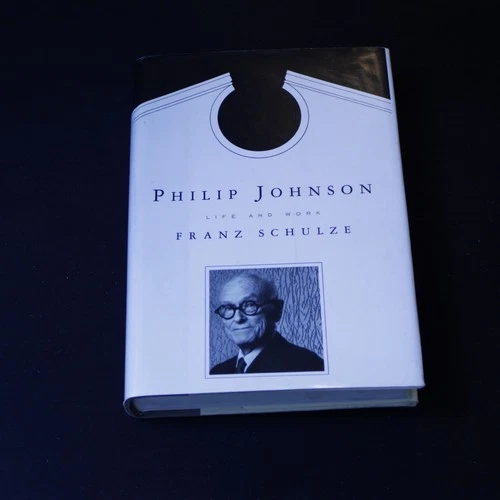

Try to picture the American Century without Philip Johnson and it immediately starts to feel a little dimmer around the edges. The architecture of the twentieth century simply does not come into focus the same way, and that is not nostalgia talking. It is a simple acknowledgment that this one man showed up at nearly every crossroads where American building decided what it was going to be. The Seagram Building with its bronze tower on Park Avenue. The Glass House in New Canaan, that transparent pavilion where he ate breakfast and watched the leaves turn. The AT&T Building that later became the Sony Building and then 550 Madison, the stone skyscraper with the Chippendale top that made the whole city argue about whether postmodernism was a joke or a rescue mission. Behind all of it stood a figure who was part architect, part museum director, part tastemaker, and part provocateur, and the person who wanted to sort all of that out in one sustained, detailed, and honest volume wrote a book that has remained the standard ever since. That book is Philip Johnson: Life and Work, and the man who wrote it is Franz Schulze.
There is a temptation, when people talk about the biggest names in modern architecture, to treat them as if they were carved from stone, as if their decisions were inevitable and their reputations settled. Schulze does the opposite, and it is exactly the right instinct for a subject like Johnson. He gives you the sweep of the career but he refuses to flatten its contradictions, because Johnson was a man who lived comfortably inside a pile of contradictions. He worked in the office of Marcel Breuer. He was the founding director of the architecture department at the Museum of Modern Art, and in that role he curated the famous 1932 show that introduced the term International Style to the American public and effectively canonized modernism as a museum object. That alone would be enough to secure his place in the record. But Johnson was also the man who, decades later, looked at the sleek glass boxes that everyone else was copying and decided that he had grown tired of them, that modernism had become a boring orthodoxy, and that the future belonged to ornament and historical reference. It is not often that a single architect manages to be both the person who imports a movement and the person who helps kill it off, and yet that is essentially the trick Johnson pulled. Schulze writes about all of it with the patience of a scholar and the readability of a storyteller, which is a harder combination to pull off than it sounds.
What makes the biography work so well is that it keeps the buildings and the man in the same frame. Architecture history can be a dry business when it becomes nothing but a list of facades and floor plans, but Schulze never lets the human figure drift out of view. He is interested in how Johnson actually thought, how he pushed and pulled against colleagues like Breuer and Mies van der Rohe, how he cultivated mentors and patronage, and how he used the museum world and the social world of New York to make things happen. Johnson had a gift for being in the room, for knowing which artists and clients mattered, and for turning attention into commissions. The biography treats that skill seriously rather than cynically. It understands that influence is a real part of how buildings get made, and it does not pretend that architecture exists in some pure realm where only drawings and details count. At the same time, Schulze does not let the charisma excuse the quieter problems. Johnson could be moody, competitive, and difficult, and the book does not shy away from any of that. It also does not sanitize the more uncomfortable chapters of his early life, including the period in the nineteen thirties when Johnson expressed sympathy for fascism, a phase that biographers and historians have had to wrestle with honestly ever since. Schulze takes that history head on rather than waving it past, and that willingness to sit with ugliness is part of why the book has lasted.
The prose itself moves in a way that rewards a patient reader. This is not a gossipy celebrity biography, and it is not a textbook either. It sits somewhere in the middle, which is the most useful territory for a subject like Johnson, because the architectural language matters but so does the personality. Schulze explains the ideas behind the Seagram Building and the Glass House so that a reader who has never taken an architecture class can grasp what was radical about them. A glass box does not sound radical on paper, until you understand that Johnson was dissolving the distinction between inside and outside, between the private world of a homeowner and the manicured lawn around it. A bronze tower does not sound especially daring until you realize how carefully Johnson and Mies handled proportion, curtain wall detailing, and the way a building meets the street. The book gives you those insights without ever talking down to you, and it links them back to the larger story of what American cities became in the postwar decades. If you have ever walked through a modern office district and wondered where that whole look came from, this is one of the books that will actually answer the question rather than just gesturing at it.
There is also a genuine case for owning this in an archive, and it goes beyond simple enjoyment. Johnson is one of the architects whose importance is only becoming clearer as time passes, because his career spans such an enormous arc of style and taste. A single biography covering the birth of the International Style, the corporate towers of the Mad Men era, the rise of postmodernism, and the late experimental works means you get decades of cultural history distilled into one volume. That makes it valuable for students of architecture and art history, for designers and developers who want context for the buildings they work around, and for anyone who enjoys a well-observed biography of a complicated public figure. The book functions as both a record of one man and a cross section of an entire period of American visual culture. That is a lot to get from a single reading experience, and it is why people still seek out this biography rather than settling for a Wikipedia summary or a glossy museum catalog.
Let me be plain about the condition on this particular copy, because I think honest descriptions matter more than anything when you are shopping online. The listing is marked Pre-Owned. What that means is that this is not a fresh sealed copy straight from a press run. It is a used book that has passed through a reader’s hands, so you should expect some normal signs of prior ownership, the kind of gentle wear that any well-thumbed volume accumulates. That could mean a slightly softened spine after someone read it across several long evenings, a corner that has been bumped a little, faint shelf wear along the edges, or maybe some light marking on the pages here and there. I am not going to pretend it is flawless, because it is not being sold as a collectors piece in untouched condition. What I can tell you is that it is a complete and readable copy of a major biography, and for someone who wants to actually sit down and read about Philip Johnson rather than simply display a mint edition on a shelf, a pre-owned copy like this is the smart, affordable way to go about it. The price is $4.89, which is a remarkably small amount of money for a book that delivers this much dense, lasting content.
Whenever I talk about shipping from this store I want to put your mind at ease about the actual mail journey, because I know that ordering a used book sight unseen comes with a certain amount of anxiety. The store, Wiredwizard, handles that part with care. Orders are moved out quickly, so you are not left waiting for days on end while your book sits unpicked on a shelf. Somewhere between the first place setting of the order and the package reaching your mailbox, the book is wrapped with protection in mind. That means packing materials chosen to keep the covers from getting dinged during transit and the corners from taking the kinds of knocks that Postal and parcel sorting machines love to deliver. The goal is for the book to reach you looking like the thoughtful pre-owned volume that is described above, not like something that has been through a demolition derby. Fast handling and sturdy packaging are the two commitments this store tries to keep on every single order, and I have no reason to think this one will be any different.
It is also worth mentioning that the biography works beautifully as a companion to actually visiting buildings, and that is a use many owners discover only after they have read it. The next time you find yourself walking up the avenue past the Seagram Building, or standing on the lawn near the Glass House, or circling a late museum or corporate tower with a Johnson signature on it, the book will add a whole layer to what you are seeing. You will know what the architect was reacting against, what he was reaching for, and what the debates of the moment were. That is the difference between looking at a building and understanding it. A biography like this turns an ordinary walk through a modern city into a running conversation with one of the people who helped shape the skyline, and that is a pleasure that does not fade on a second or third reading. For anyone who works in design, real estate, urban studies, or the arts, that kind of informed looking is genuine professional capital, and the book delivers it on every page.
There is one more point I want to make about why this particular biography has held up so well, and it comes down to the fact that Johnson never stopped being interesting, even late in life. The book follows him through his return to prominence in the postmodern years, when he seemed to reinvent himself once more and made the old guard uncomfortable in the process. That late-career arc is often dropped from shorter treatments of his work, so a full biography that carries the story all the way to the end is genuinely valuable. You come away not just with the famous early works but with a sense of the entire restless journey, the same man picking up new ideas, discarding old ones, and refusing to go quietly into the history books. That completeness is rare, and it is one of the strongest reasons to own a full-length biography rather than settle for a summary.
If this biography fits what you have been looking for, whether you are stocking up for a long reading project, adding to an architecture reference shelf, or buying a gift for someone who never gets tired of talking about great buildings, then the next step is straightforward. Head over to the eBay listing, give the copy a close look, and if everything checks out, place your order with confidence. You can find the exact listing at the URL for this item, and the store you will be buying from is Wiredwizard. Between the low price, the genuinely important content, and the careful shipping, this is one of those purchases that tends to leave a reader feeling like they got the good end of the deal. Philip Johnson changed the way America looked at its own skyline, and this biography is the best single doorway into understanding how he did it. If that is what you have been after, do not let the copy slip past you.
Now, for anyone still weighing things, I want to answer a few of the questions that tend to come up most often about this particular book and this particular listing. There is no harm in being thorough before you buy, and it is exactly the kind of due diligence a careful online shopper should be doing.
AI FAQ — Philip Johnson: Life and Work by Franz Schulze
1. Who was Philip Johnson?
A. Philip Johnson was one of the most influential American architects of the twentieth century. He directed the architecture department at the Museum of Modern Art, was a champion of the International Style, and designed landmarks including the Glass House and the Seagram Building, among many others.
2. What is this biography about?
A. It is a full-scale biography by Franz Schulze that traces Johnson’s life and career, from his education and early years through his work as a museum curator and tastemaker to his most famous buildings and his turn toward postmodernism in his later decades.
3. Who wrote the book?
A. The author is Franz Schulze, an art historian and critic who is widely regarded for his writing on modern architecture and German and American art. His biography of Johnson has long been treated as a standard scholarly source on the architect.
4. Does the book cover only his famous works?
A. No. It covers the famous works in detail, but it also explores his role at the Museum of Modern Art, his relationships with colleagues, his commissions, his ideas over time, and the less celebrated parts of his career and personality.
5. Is this book appropriate for someone who is not an architecture expert?
A. Yes. Schulze explains the architectural ideas clearly, so a general reader can follow along even without formal training in architecture. It works for students, professionals, and curious general readers alike.
6. Does the biography address the controversial parts of Johnson’s early life?
A. It does. The book does not shy away from the period during the 1930s when Johnson expressed sympathy for fascism, and it handles that chapter honestly as part of a full portrait of the man.
7. What is the reading level and tone of the book?
A. It is scholarly in its rigor but written to be read, not just consulted. The tone is measured and observational rather than gossipy, and it rewards a patient reader who wants depth over sensation.
8. What condition is this specific copy in?
A. The listing is marked Pre-Owned, meaning it is a used copy that may show gentle wear such as light shelf wear, a softened spine, or minor corner bumps. It is sold as a complete, readable copy rather than a mint collector item.
9. Why is this book still considered important today?
A. Because Johnson’s career spans so much of American visual culture, the biography functions as both a portrait of one man and a history of modern architecture from the rise of the International Style to postmodernism. That makes it a lasting reference.
10. What does it cost, and what kind of value does it offer?
A. The price is $4.89. For a substantial major biography with lasting reference value, that is a very small outlay, especially given the density of useful and interesting content packed into the book.
11. How is the book shipped from this store?
A. The store, Wiredwizard, ships orders out quickly and packs them with protective materials to guard the corners and covers against damage during transit, helping the book arrive in good shape.
12. Where can I find this copy?
A. The exact listing is available at the eBay URL provided for this item, sold through the store Wiredwizard. From there you can review the listing details and place your order if everything looks right.
Buy it on eBay
Get this item now at the Wiredwizard eBay store: this listing on eBay.