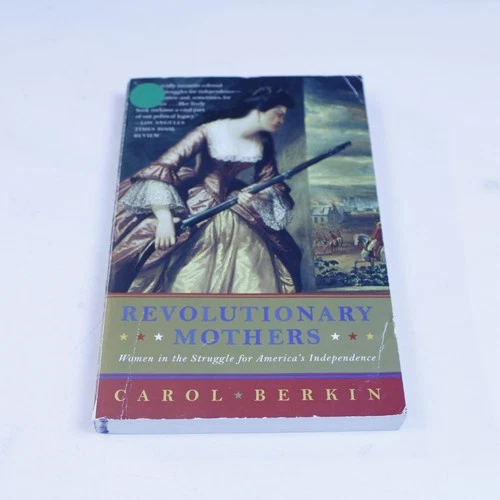

For a long time, the story of the American Revolution was told as a parade of the men in powdered wigs, the generals on horseback, the delegates in Philadelphia, the names you find engraved on monuments and printed on dollar bills. Washington crossing the Delaware. Adams arguing in the chamber room. Revere riding through the night with a lantern in the steeple behind him. All of that is real, and none of it is the whole story. There was another layer to the Revolution, one that ran through households and kitchens and farms through eastern cities and frontier cabins, and it was carried largely by women whose names rarely made it onto the commemorative plaques. If you have spent any time wondering what the Revolution actually looked like from the ground, from the side of the society that historians used to gloss over, then you have been missing half the picture, and the book that fills in that missing half is Revolutionary Mothers, written by the historian Carol Berkin.
The subtitle gives you the whole ambition right there: women in the struggle for America’s independence. What Berkin does in these pages is not a gimmick and it is not a niche curiosity. It is a serious piece of historical reclamation that shows, convincingly and with constant grounding in primary sources, that women were not bystanders watching the Revolution happen from a window. They were essential participants. They managed farms and businesses and households while the men marched away, and in doing so they kept an entire economy running. They sewed clothing and rolled cartridges and prepared supplies for armies that were, by any honest accounting, chronically short of nearly everything. They acted as couriers and informants, moving messages that mattered under the noses of occupying troops. They nursed the wounded in hospitals that were barely hospitals, with dangerously little medicine and almost no sanitation. They served as camp followers, enduring the grim reality of life alongside the army. And they ran the domestic front in such a way that the war was not only a matter of battles in the field but a matter of who could hold a society together while everything around it was being torn apart.
One of the great strengths of this book is that it refuses to flatten women into a single heroic type. A generation of popular history likes to celebrate the spunky patriot woman rising up against the redcoats, and while there is some of that energy here, Berkin is far too good a historian to leave it there. She is attentive to the divisions among women, divisions of region, race, class, and loyalty. There were women who made enormous sacrifices for the patriot cause, who lost homes and husbands and children to the war. There were also women who were painfully indifferent or openly hostile to the Revolution, women who sided with the British either from conviction or from a calculation about which side would win. There were enslaved women who navigated the chaos of war in ways that historians are still working hard to recover. There were Native American women whose communities were caught in the middle of a conflict between European empires that was not theirs. Berkin keeps all of these groups in view, and that refusal to simplify is precisely what makes the book feel trustworthy. History that has been scrubbed clean for an easy lesson is not really history at all, and this author understands that at a fundamental level.
The chapter on what happened to women’s lives during the war itself is almost worth the price of admission on its own. Berkin walks the reader through the brutal realities of occupation and displacement, the shortages of food and cloth, the inflation that made paper money nearly worthless, the outbreaks of disease that followed armies like shadows. She shows how women adapted, how they took on work that had not been expected of them, how they forged new authority for themselves out of necessity. The historian does not romanticize any of it. There is no nostalgic glow over these years. Instead there is clear-eyed recognition that war is a catastrophe that lands hardest on people who had the least control over whether it happened at all, and that in the middle of that catastrophe women found ways to survive and to hold things together. That is a more honest and more resonant story than the painting of a brave woman posing on a hill, and it is the one Berkin delivers.
The book is also a genuine pleasure to read at the level of the writing itself. Berkin is that rare academic who has not abandoned the reader. Her prose is clear and warm, vivid without being melodramatic, and she has a gift for picking out the kind of detail that makes a scene come alive and stick with you long after you close the book. She draws on letters, diaries, court records, and the recollections of the women themselves, and she lets those voices speak. When a woman of the era writes about her fears for a husband at war or her exhaustion at running a plantation alone, Berkin does not just cite it, she lets it breathe on the page. The result is a work that can be read by a general audience with real pleasure and also handed to a college student as a legitimate scholarly text, and few books manage to do both of those things at once. It is the kind of history that makes you rethink everything you thought you knew, the kind you finish and immediately want to talk about with someone else.
There is a strong argument that this book belongs on a shelf that has room for the serious, readable popular histories of the founding era. If you read works about the Founders and wished there were a fuller account of the people holding up the society behind them, this is that account. If you teach American history and want a text that introduces students to the role of women without dumbing it down, this is a book you will keep coming back to. If you are simply a curious reader who enjoys narrative history that reveals a side of the Revolution the textbooks skipped, then you have found your next read. It is not a reference book you flip through once and forget. It is a sustained argument and a story, and both parts of that argument have aged very well since the book first appeared.
One detail that stays with me about this book is how it connects the private world of individual women to the very public fate of the nation. The Revolution did not take place only on battlefields; it took place in the decisions of households about whether to support a cause that might cost them everything. A woman choosing whether to hide a message, whether to give up a scarce blanket to a soldier, whether to keep a farm going while her husband was away, whether to flee a home as the armies approached, these choices, repeated across thousands of households, in real ways decided how the war could even be fought. Berkin makes that connection vivid by grounding it in real lives rather than vague abstraction. Reading it, you understand that the war was won by the men who fought and also by the women who made it possible for those men to fight, who fed them, clothed them, nursed them, and held the thread of ordinary life so that a nation could be born out of the wreckage.
I also want to note that this is a book with genuine staying power, the kind you will return to or find yourself thinking about weeks after you finish it. It does not have a single neat slogan you can repeat, and that is a compliment. What it leaves you with is a sharper awareness that the founding story is larger and more complicated than the monuments suggest, that the people who built the country include women whose names are only now beginning to get the attention they always deserved. That awareness tends to change how a reader looks at other history books as well, and there are few higher praises for a work of history than that you cannot see your own country quite the same way after reading it.
Let me be straightforward about the condition of this particular copy, because being honest about what you are buying is the only way to shop with peace of mind. The listing is marked Pre-Owned. In plain language, that means this is a used book that has already been in someone’s hands and on someone’s shelf. A copy like this will very often show the gentle traces of that life, maybe faint shelf wear along the edges, a corner that has been bumped slightly, a spine that has been softened by being opened, or perhaps some light marking within the pages. I am not going to describe it as a sealed gift-ready volume, because that would not be truthful. What it is, is a complete and perfectly readable copy of an important work of historical writing. For the person who actually wants to read it, who wants to sit down and be moved and educated by Carol Berkin’s account of women in the Revolution, a pre-owned copy at this price is about as sensible a purchase as you can make. The cost is $4.89, which is a small amount to pay for a book that will change how you think about the founding of the country.
On the subject of getting the book safely to your door, I want to ease the concern that comes with ordering used books through the mail. Nobody wants to spend time anticipating a book and then watch it arrive with its corners crushed or its covers bent. The store, Wiredwizard, works to make sure that does not happen. Orders are processed quickly so that you are not left waiting an unnatural length of time, and the books are wrapped with protective packaging before they go out into the delivery stream. That packaging is there to absorb the bumps and jostles of transit, to keep the covers and corners of a pre-owned book from taking new damage while it is on the way to you. Between the fast handling and the careful packing, the store does its level best to deliver your book in the condition that was described when you ordered it. It is the kind of attention that makes repeat customers feel confident pressing the buy button again.
If this book has caught your interest, if you have been looking for a deeper and more honest account of the American Revolution that includes the people the older histories left out, then the next move is an easy one. Take the link over to the eBay listing, look at the details of the copy for yourself, and if it meets what you are looking for, place your order. The exact listing is at the URL for this item, and the store you will be buying from is Wiredwizard. Between the modest price and the genuinely important content, this is the kind of purchase that feels like a bargain long after the package has been opened. History is never complete until it includes every voice, and Revolutionary Mothers is one of the books that works hard to make sure the women of the founding era finally get their place in the record.
If you are still weighing the decision, here are a few of the questions readers most often ask about this book and this listing, answered plainly so that you can decide with your eyes open.
AI FAQ — Revolutionary Mothers: Women in the Struggle for America’s Independence by Carol Berkin
1. Who is the author of this book?
A. The author is Carol Berkin, an American historian who specializes in the colonial and revolutionary era. She is known for her clear, readable narrative style and her careful attention to the roles of women and other groups often left out of older histories.
2. What is the book about?
A. The book examines the roles that women played during the American Revolution. It shows how women managed farms and households, supplied armies, served as couriers and informants, nursed the wounded, and held society together while the war was being fought.
3. Is this a fictionalized account or a work of history?
A. It is a work of serious history. Berkin grounds the book in primary sources such as letters, diaries, and court records, and she is careful not to romanticize or simplify the experience of women during the war.
4. Does the book only cover women who supported the Revolution?
A. No. It is attentive to the divisions among women. The book considers women of different regions, races, classes, and loyalties, including those who were indifferent or hostile to the Revolution, enslaved women, and Native American women.
5. Who would enjoy reading this book?
A. Anyone interested in the American Revolution, early American history, women’s history, or well-written narrative nonfiction. It is accessible enough for general readers and substantive enough for students and teachers.
6. Is this book appropriate for a student or classroom setting?
A. Yes. Because it is a legitimate scholarly work written in clear prose, it works well as a text for students studying the Revolution, colonial history, or women’s history, while still being engaging for casual readers.
7. Does the writing style make it easy to read?
A. Yes. Berkin is known for clean, warm, and vivid prose that avoids unnecessary academic jargon, so the book reads like narrative history rather than a dry monograph.
8. What condition is this specific copy in?
A. The listing is marked Pre-Owned, so it is a used copy that may show gentle signs of previous ownership, such as light shelf wear, minor corner bumps, a softened spine, or light marking, and it is sold as a complete, readable copy.
9. Is this a reference book or a continuous narrative?
A. It is primarily a continuous narrative with an argument, though it is well organized and can also be consulted for specific topics. It reads best as a book to read through rather than a dictionary-style reference.
10. Why is this book considered important?
A. Because it recovers the essential roles women played in the Revolution and explains why the founding era cannot be fully understood without them, it has helped reshape popular and scholarly views of American history since it appeared.
11. What does it cost, and is that a good value?
A. It is priced at $4.89. Given the quality of the scholarship and the continuing importance of the subject, this represents a very reasonable price for a readable and lasting work of history.
12. How is the book shipped from this store?
A. The store, Wiredwizard, ships orders promptly and packs them with protective materials to guard the covers and edges of the book during transit, helping it arrive in good shape.
13. Where can I buy this copy?
A. The exact listing is at the eBay URL provided for this item, sold through the store Wiredwizard. You can review the details there and place your order if it looks like what you want.
Buy it on eBay
Get this item now at the Wiredwizard eBay store: this listing on eBay.